Wednesday, August 16, 2023

Loire Valley wine and riding

On our second day in the Loire Valley, we rode to a winery for a tasting and a tour of the caves where the wine is stored.  After a stop for lunch, we were scheduled to ride on to the "Sleeping Beauty Castle, but a rainstorm dampened our spirits a bit.  The van took us to the castle which does look like Sleeping Beauty is inside, but we did not go inside as only the outside is impressive. 


Then we got back on the bikes.  It was a long day of riding but mostly along the rivers, through two (certified) most beautiful villages in France, and on small roads by vineyards and farms.  There are far more bikes on the road than cars, many carrying their belongings in saddlebags.  The riding is so popular and so great here that I almost feel like I could manage a trip without Backroads.  Almost.  It is nice to have everything arranged and a van to go into when it rains.  Tonight they took us to a farm-to-table restaurant where I expected not to like the meal.  Farm?  Sounds like vegetables to me.  But I thought the food was great - foie gras (again) and duck.  I could turn into a foodie if I spent more time in France.  Nah.  Not likely.  I did have a glass of wine with dinner.


On Tuesday we rode to another winery for a tour and tasting.  I could become a wine connoisseur.  Nah.  Then we rode to the lovely town of Amboise which has not one but two chateaux.  We expect to come back to visit Chateau Amboise, but today we visited Clos de Luce where Leonardo da Vinci spent the last three years of his life.  Besides his bedrooms and art studios, the chateau has his drawing and working models of several of his inventions such as:  a car, an airplane, a parachute, a bicycle, various types of machine guns, various types of bridges, and lots of things with gears and pulleys that were beyond me.

Airplane invented by da Vinci

Seriously, this is a car.

Our hotel tonight is not a chateau but a hunting lodge which is even nicer than the chateau we stayed in.  French royalty apparently treated themselves quite well.

To give our legs a rest, we blew off the morning ride on Wednesday and got driven to the incredible Chenonceau Chateau.    Built on the north side of the river, the owner wanted to hunt on the other side without having to ride around, so she built a bridge from the chateau.  Later, when Catherine de Medici owned the chateau, she enclosed the bridge into a long ballroom.  The gardens are beautiful here as well.  The last time I was here, the weather was so rainy and windy that I have pictures of myself with my hair blowing straight to the side.  This week we have really lucked out with the weather.  The temperature is warm but not hot, and everything is in bloom from previous rain.

Another ride through small villages and rolling countryside.  Another great French meal topped, tonight with creme brulee.


Sunday, August 13, 2023

Day One in the Loire Valley

Today Margie and I met our guide, Leon, and went on our first ride to our first chateau.  It will not be the last.  Chateau Villandry is an okay chateau with the most incredible gardens that go on forever.  Pictures do not do justice to this one.  For lunch I had my second crepe of the trip.  It will not be the last.


The bike riding was as close to perfect as it gets.  Lovely small roads with few cars and, unlike in America, I don't feel that every car is trying to kill me.  Here, the cars respect riders and do not run them off the road.  Concept!  On one stretch of a one lane road I think I went half an hour without even seeing a car.  The weather was perfect as well - warm but not too hot or humid, and no wind.  Leon, our guide said that it rained the whole time on his last trip here, but we have totally lucked out.  Periodically the road goes through small villages.  This is as good as riding gets.

After touring the chateau, we biked to our hotel which is ... Chateau de Rochecotte.  But this is a much more modern chateau - from only the eighteenth century.  And of course updated to twenty first century four star standards.  We got in too late to go to the swimming pool but we are staying here another night, so maybe tomorrow.  Dinner here at the hotel tonight was incredible.  I said I wasn't going to do it, but I ordered foie gras.  It was great!  I am sorry for the geese, but sometimes you have to make a sacrifice.


Tours


In a whirlwind day and a half, Margie and I saw the best of Tours and ate good food.  Tours has a lovely Old Town where cars are not allowed, so after arriving on Friday afternoon, we joined the crowds just walking around, and eventually ended up at the very impressive cathedral.  We loved the stained glass windows there.


And then, of course, French food for dinner.  I had my first escargot of the trip, but they won't be my last.

On Saturday we headed back to the Old Town to visit the Musee de Beaux Arts and the Musee de Compagnonnage.  The latter shows the work of artisans from various medieval guilds.  We also walked one more block to get our first glimpse of the Loire River which we will be following extensively on our bikes.  Finally we went back to the heart of Old Town to see the half timber houses that Tours is famous for.


I skipped dinner and went straight to my first crepes of the trip.  That definitely will not be my last.

And tomorrow we are off on our bikes.


Monday, February 27, 2023

Argentinos and other people

There are a few cultural things that mystify me about Argentinos besides their “tranquilo” attitude.  They patiently stand in long, unnecessary lines.  For example, they line up at bus stops, but some people sit on benches and others walk in from the other direction when the bus arrives.  No one seems concerned about line cutting; I’m not sure they even have a concept of it.

They also stand patiently in long lines to take their pictures at tourist sites and they don’t just stand smiling in the pictures.  They strike extravagant or sultry poses.  In my neighborhood of San Telmo in Buenos Aires there was a full size statue of Mafalda, a famous cartoon character, sitting on a bench.  Every evening and all day on Saturdays and Sundays, people stood in line to take their picture sitting on the bench next to her.

At the summit on our drive to La Gran Salida, they stood in line to take their picture next to the altitude sign.  I even stood in line with them, something I rarely do voluntarily, but I was going to have to stand around waiting anyway for everyone to take a picture, so … 


But at La Salinas Grandes, there were six platforms, apparently with photographers on each, and people stood in lines at each of them to pose and take a picture.  Why?  The salt flat was huge.  They were all taking pictures of themselves with their cell phones.  Jumping over the swimming pools was very popular with the photographer catching you in midair.  Why would you wait in line to have someone take a picture of you that you could take anytime ten feet away with the same view.  There are just some things that I never understand.

Hard to see but these are lines of people to take pictures in a wide open space

Another apparently cultural thing:  the Argentinos applaud when their plane lands, something I have not experienced since flying to Israel in the 1970’s.  They also applaud politely when the tour guide introduces himself, again when he introduces the driver, and again at the end of each tour separately for the guide and driver.

I have met some interesting people, Argentine and otherwise, on my various excursions. On the Humahuaca bus I sat next to a very nice young Frenchman who was on his way to Bolivia to climb mountains.  He had all his things with him and a bus ticket for 2:30 AM that night but ended up staying in Humahuaca to try his luck at the bus terminal there because he didn’t believe he would make it back in time to catch his bus.  After our seven hours of delays, he was probably right.


The next day I sat next to a very nice young Argentine man who was on vacation from Buenos Aires.  As we drove through the beautiful Quebrada, he told me it reminded him of the Grand Canyon.  He took out his phone and showed me a picture of himself there.  I still say it reminds me more of Utah, but I can’t argue with him.  I had told him that I could understand him if he spoke a little slower.  The usual conversational speech of most Argentinos is a little too fast for me to decipher.  He obligingly slowed his speech waaay down.  Where… are…you… from?  But it worked.  We conversed at length.

Sports turns out to be an instant identifier for people you meet when traveling.  I talked to a couple around my age who were vacationing in Salta.  I asked where they were from and they said, Rosario, about 300 north of Buenos Aires.  I know, I said, it is where Messi is from.  (I had been listening to a podcast in Spanish about Messi while walking to and from school or I would never had known where he was from.)  When I was talking to the young Frenchman, he asked where I was from.  California, I said.  Los Angeles, San Francisco? he asked.  Sacramento, I said, it’s near San Francisco.  I know, he said, I am a fan of the NBA.

One day during my month in Buenos Aires, I was sitting in my local park in San Telmo reading on my kindle when a man sitting near me asked me the time.  I told him.  He then said, it sounds like you have an American accent and started talking to me in English.  He asked what I was reading, and then asked if I had read William Faulkner.  Not my favorite, I replied, although by coincidence I had recently reread As I Lay Dying.  He then proceeded to lecture me on how great Faulkner is and what an influence he was on other writers.  Have you read One Hundred Years of Solitude, he asked.  Twice, I replied.  Well, he said, Faulkner had a big influence on Gabriel Garcia Marquez.  Then he discussed sections of As I Lay Dying in detail, and somehow he moved on to Italian history which he lectured me on as well.  The man appeared to be older than me and was rather shabbily dressed.  I would have believed that he was one of the beggars in the park. But when I asked him how he spoke English so well, it turns out he is an artist and had a gallery in New York for years.  He couldn’t describe his art, so he gave me his name and told me to Google him.  I did and quickly found and read a New York Times article about him.


My walking tour in Salta was disappointing, but I ended up talking in English to a woman from Russia who lives in Germany.  She has a PhD in some esoteric subject connected to social philosophy.  What is that? I asked.  Have you read Hannah Arendt? she asked.  By coincidence, I had recently reread one and a half of her books.   She seems a bit dated to me, I said.  Of course, she replied, she was writing about a specific type of totalitarianism in the 1930’s.  We then proceeded to have a long discussion about the banality of evil and how “ordinary” people can do such horrible things.


I do meet such interesting people when I travel and somehow, I rarely have conversations with strangers about Faulkner or Hannah Arendt in Sacramento.


Bariloche


Bariloche is a small city on the shore of Nahuel Huapi Lake, and is the jump-off point for visiting the dozens of lakes and mountains in the lake district which is the northern part of Patagonia.  In the winter this is a big ski area.  I arrived early enough on Tuesday to take a tour that I was interested in but that is only given three times a week:  the German footprint tour and Nazi presence.  In two months of touring in Argentina - and I have taken a lot of tours - the only guide to ever mention the Nazis was Rabbi Ernesto on my second day in Argentina, and he focused on the kidnapping of Eichmann.  I have heard a lot about what a great populist Juan Peron was, how much he did for the poor and working class.  But he was president from 1946 to 1955, the period during which Argentina took in many high-profile Nazis, and no one has said a word about Peron’s role.


As it happens, the Bariloche area is the center of a German community in Argentina that arrived in three waves:  disappointed revolutionaries in the mid-19th century, disappointed or displaced people in the interwar years, and refugees after World War II.  According to the guide, fifteen million Germans left in the mid-19th century with thirteen million going to the United States.  The next biggest group - several hundred thousand - came to Argentina which welcomed immigration at that time, and while some stayed in Buenos Aires, many came to the Bariloche region because it is so similar to Bavaria.  Here they established hiking and ski clubs.

There were two ways that Nazis came to Argentina after World War II according to the guide:  the scientific route and the “ratline.”  Peron did welcome several scientists who he hoped would bring nuclear and other technology to the country.  The “ratline” involved false identities and sponsorship by the Vatican.  The guide was not willing to put any blame or even tacit acceptance on Peron.  False papers equals deniability.  But, I said, everyone knew the Nazis were here.  Why were they so accepted?  He said other countries did the same thing including Brazil, Paraguay, Canada, and the US.  Not an answer.  He was quick to assign blame to the Vatican, maybe even the pope, and to draw comparisons to other countries.  He had already discussed the huge 1938 rally in Buenos Aires by over 12,000 Nazi supporters celebrating the Anschluss, and quickly pointed out that it was not the largest such rally in the Americas.  A rally later that year in Madison Square Garden was attended by more than 20,000.  Also, as specific as he was with the number of German immigrants in the 19th century, when I asked if Argentina took in Jewish refugees before and after the war, he said, of course, but was very vague on numbers.  Now I am curious about why so many Nazis came here and how welcoming Argentina was to the Jews.

For the next three days, I took excursions to see the various lakes and mountains.  The first day was the Short Circuit to the nearby mountains.  We took a chair lift to the top of Cerro Companario, and in the afternoon, a gondola and then a chair lift to the top of Cero Cathedral, one of the tallest mountains.  This is the view from the top. The next day we took the route of seven lakes to see …  well, the name is pretty descriptive.  And the third day, a boat ride across the lake to Puerto Blest to see a waterfall.  You could continue from there to cross the Andes to Chile but I returned to Bariloche.


Absolutely beautiful country again, and so different from either southern Patagonia or the Salta area.


I returned to Buenos Aires for my last few days.  When I was here on the night of Carnaval, there was a huge line in front of my hotel.  I tracked it to the end, thinking it was a theater or nightclub, but it went to a pizza place.  Now it was an ordinary Saturday and the line was just as long.  I looked it up online and discovered that this pizza place is reputed to have THE BEST pizza in Buenos Aires.  I’m not willing to stand in line for pizza, so I went there on Sunday for lunch.  Not bad but I’m not sure it was that much better than other pizzas I have had here.

After lunch I went to the Holocaust Museum to get answers to my unanswered questions from Bariloche.  The Holocaust Museum in Buenos Aires is the only holocaust museum in South America.  It turns out that Argentina, which had been very open to immigration in earlier years, passed a law in 1938 refusing immigration to anyone who was stateless and/or had been evicted from their own country.  In other words, Argentina refused to take in refugees of conquest or displacement by the Nazis.  Without using the word “Jewish,” Argentina closed the door to Jews.  During the war, Argentina was neutral until 1944 when they joined the Allies.  After the war, Argentina again refused to take in refugees.  Nonetheless, over 5,000 Jews arrived, most illegally.  In 1949 Argentina granted amnesty to anyone who had arrived illegally.  At first I thought that meant the Nazis, but I realized that they had come with false papers so is that legal or illegal?  Eichman had a pass of safe conduct from the Red Cross.  Now I can understand why the guide in Bariloche was vague to the point of misleading, and I still don’t have an answer to one (well, two) questions:  what did Peron know and why was Argentina so welcoming to fleeing Nazis?

I have been thinking about my son-in-law, Joe, who loves trains and all forms of transportation.  In two months in Argentina I have been on:


  • innumerable subways and city buses

  • many tour buses

  • a train to and from Tigre

  • a cruise ship with multiple zodiac excursions

  • a ferry to Colonia, Uruguay

  • four more boat rides

  • two horseback rides

  • one gondola and two chair lifts

Except for taxis, I have not been in a car.  I have now had the best pizza in Buenos Aires and can’t think of any more modes of transportation, so I guess it is time to come home.


Tuesday, February 21, 2023

If it's Jujuy it must be Utah


I am staying in Salta for five nights to visit the scenery in the Jujuy (pronounced hoo-hooey) province.  Fortunately, Salta is centrally located; unfortunately the distances are quite long, so our daily trips are scheduled to start before 7 in the morning and end after 8 at night.  All of the tours are in Spanish with primarily Argentine tourists.  In general, I can understand about half of what I can hear.


My first trip - to Cachi - was underwhelming.  The highlight was a twenty mile switchback climb over Cuesta del Obispo (the Archbishop’s Slope).  It was one of those amazing feats of engineering with a great view at the top.  Then we descended into the Valle Encantado (Enchanted Valley) where the guide told us we were going to see the biggest cardones in the world.  Since I didn’t know what a cardon was, I had no idea what we were going to see.  But I soon figured it out.


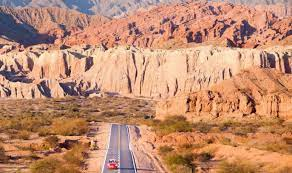
On my second trip the scenery went from good to spectacular.  The Quebrada de los Conchas are red rock mountains with straight up cliffs.  They are so named for the fossils of seashells (conchas) that can be found in them.  It felt like I was in Zion National Park.  And our lunch and shopping stop in Cafayate was much nicer than in Cachi the day before. In Argentina, the national stone is rose quartz and I might have bought a few necklaces. In the Quebradas, the stone is onyx in different colors ... and I might have bought a few.


I was expecting the third day to be the highlight as we were going to Humahuaca to see the famous Quebrada de Humahuaca, a narrow mountain valley with dramatic and colorful mountain formations.   The day did not begin auspiciously.  I was scheduled to be picked up between 5:30 and 6:00 so I dutifully got up at 5:15.  Ugh.  The bus finally arrived at 7:00.  I was not happy.  I could have slept another hour.  Then, after driving for just over an hour, the bus broke down.  We limped into a gas station/mini-mart, where they told us we would wait for an hour or so for another bus.  One hour went by, two hours.  Did I say I was not happy this morning when we were only an hour late?  And I’m the only one who seems to be upset.  I went outside and told our guide we were never going to get to Humahuaca.  Of course we will, he said.  An Argentine woman told me you have to stay positive.  She shrugged her shoulders:  it was a mechanical problem.  What can you do? The bus finally arrived after nearly three hours and we set out for Humahuaca just after noon.  Four hours late.  Seriously?  I figured we would have to turn around sooner than later.


But I calmed down when the spectacular scenery I was expecting began.  The colors of the Quebrada mountains are just amazing. This was one of the views from the window of the bus. The mountains did not seem to be bare rock but looked like they had scattered trees on them. When we got closer, I saw it was the cardones (elephant cactus) that I had seen earlier dotting the hills. Such an unusual landscape.


The tour company had warned us that it was Carnaval this weekend in Jujuy province and we were not making the usual two hour lunch and shopping stop so I thought we might make up some time.  Nope.  They just meant we were going to a different town for our two hour lunch and shopping stop. We went to Purmamarca, a delightful market town full of colorful shops and stalls.  Yes, it is all for the tourists, but I liked it nonetheless.  Did we shorten our stop?  No.  We left Pumamarca at 4:00 and hit stop-and-go bumper-to-bumper traffic from all the people driving to Humahuaca for Carnaval.  I couldn’t believe that we continued to drive north.  At 4:40 I saw a road sign that said 48 kilometers to Humahuaca.  But we were barely moving.  At 5:40 the next sign said 42 kilometers.  Then we came to a complete stop as the road through Tilcara was blocked by a Carnaval parade.  We stopped again in Uquia for another Carnaval event.  Then we stopped for a photo op at the marker for the Tropic of Capricorn.  (Really? We can't skip anything?) At 7:20 I saw another sign that said 11 kilometers to Humahuaca.  We finally arrived around 8:00.


We walked around Humahuaca for a while where Carnaval was in full swing.  The town was rocking.  People paint their faces and wear devil masks and costumes.  There was lots of live and recorded music blaring everywhere and periodic parades.  People also walk around with aerosol cans of something like silly string but it is white confetti.  They spray that and white powder on everyone they walk by. Uncostumed peple paint their faces.


Our guide took us to a restaurant and asked if we wanted to take our food to go on the bus or eat there.  The Argentinos unanimously wanted to stay there and eat.  So we stayed in Humahuaca until after 10.  Since service in restaurants is beyond slow, I had more time to walk around and experience Carnaval.  Typically, the ride to Salta from Humahuaca is three hours. We left Humahuaca around 10 but with the delays of Carnaval …  I was dropped off at my hotel just before 3 AM. My phone and hearing aids had died but fortunately my Kindle had enough charge for the day (and night).


I thought about blowing off my last tour to Grandes Salinas (Big Salt Flats) but, hey, I can sleep when I’m back home.  I was scheduled to be picked up between 6:30 and 7:00, I dutifully got up at 6:00 after three hours sleep, and the bus arrived at … 8:00.  I’m getting the hang of Argentina.  I really did not know where Grandes Salinas was; I thought it was south in the direction of my first two tours, but we went back on the road to the north through the amazing Quebrada.  Well worth the drive.  Also, the colors were more vibrant earlier in the day. This time we drove on another amazing switchback road over a 13,000 mountain.  The views just keep getting better.


I’ve seen other salt flats and mines, and was not expecting much, but it really was fascinating. It was huge!  In one section they let cars drive.  In the main section, people walk around and look at the “swimming pools.”  They cut long narrow holes in the salt to collect rainwater, and then harvest the salt when the water evaporates. The salt flats stretch for miles and look like a giant ice skating rink, but obviously, the surface is solid and tastes like salt. Duh!


After Grandes Salinas, we went back to Purmamarca, the market town I had been to the day before, and the site of the Cerro de Siete Colores (the Hill of Seven Colors).  Since I had already explored the markets and bought more than I should, I found a small, quiet parilla and had one of the best meals I have had in Argentina.  A parilla is a grill, and an authentic parilla is over an open wood burning pit.  This was an authentic parilla.  Also, Carnaval was going on in Purmamarca that day, so I got to see the dancing devils and get sprayed with white powder again.


Traveling with just Argentinos was an interesting experience.  If there had been other Americans on the bus, we would have complained to each other and worked ourselves up over the terrible service.  But no one was upset at the delays or concerned about arriving home six hours late in the middle of the night.  On the plus side, if the bus had not broken down, we would have left  Humahuaca long before dark and I would not have had the chance to see the Carnaval celebrations.  I finally understand how the Argentinos can eat dinner at 9 or 10 at night.  First, they cannot tell the difference between on time and four hours late.  Second, they really mean it when they say “tranquilo” to everything. (Tranquilo means roughly: relax, chill, no worries, hakuna matata.)  And third, they can fall asleep anytime, anywhere.  They all got their sleep on the drive up and the drive back. Outside of Buenos Aires, a lot of shops do close for a couple of hours at midday.


Back in Salta … on my last day I had until 4 before I had to go to the airport to return to Buenos Aires.  Amazingly, there is a free walking tour of Salta every morning, so I signed up.  But there wasn’t much to see because it was … Carnaval … and February 20 … and a Monday.  A triple reason for everything to be closed.  February 20?  It turns out that the famous Battle of Salta in the Argentine war of independence was won by General Belgrano on February 20, 1813. Who knew? So after taking us to one old building, the guide took us to the Gaucho parade that celebrates this historic military victory.  Lots of people dressed us in gaucho clothes and riding horses.  Interestingly, there were several women riding side saddle.


My transport to the airport was scheduled for 4:10 and he came around 4:45.  Tranquilo.  I finally got back to my hotel in Buenos Aires at 10 at night where the streets are packed because … it is Carnaval.  A great time to be in Argentina.  Next I am off to Bariloche, the gateway to the northern part of Patagonia.  It is full of lakes and mountains which I will see on long bus tours.  I wonder how long a 12 hour tour takes in Bariloche.


Tuesday, February 14, 2023

Patagonia: more beautiful scenery

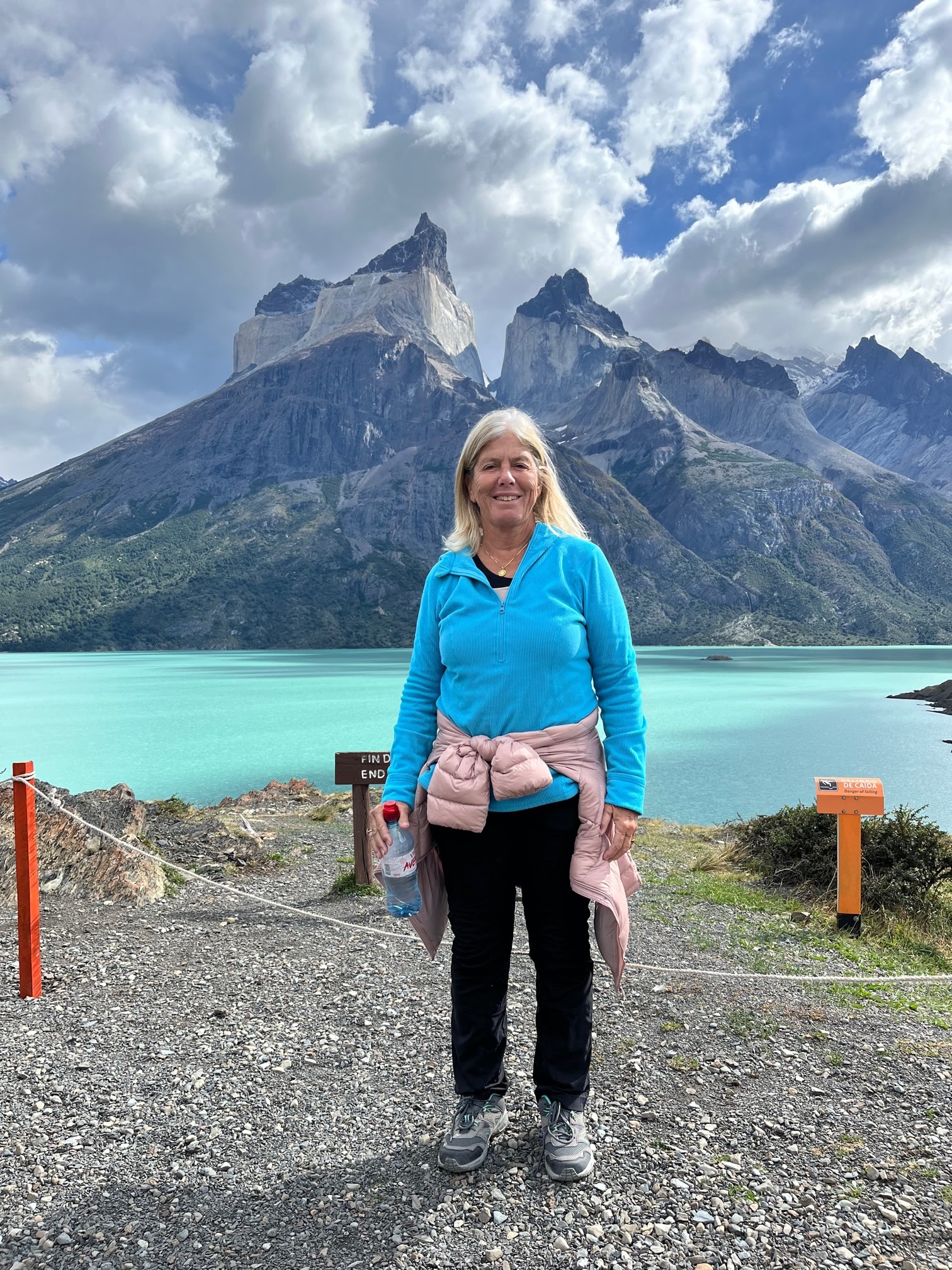
Two Horns Mountain

Our cruise ended in Punta Arenas and we had a long drive to the national park of Torre del Paine.  Think Montana - rugged mountains and blue-green lakes.


Mirror lake of a glacier

We stayed for two nights at the lodge in the park, and explored on horseback the second day.

The next day we had a six hour drive to El Calafate and the reason that I chose this particular tour.  I wanted to see the Perito Moreno Glacier, which is supposed to be one of the biggest and most spectacular of all the glaciers.  And it is.  

Unlike the stunning scenery at Torre del Paine on the Chilean side of Patagonia, the drive to El Calafate is mostly through bare scrubland.  We stopped on the way at sheep estancia (ranch) where we were served lamb asada and given a demonstration of the sheep dogs and shearing.

After a night in El Calafate, we drove to the Perito Moreno Glacier.  Words cannot do this one justice.  It is HUGE.  It stretches more than fifteen miles from the ice fields to the lake in front of it.  We observed it from the opposite shore.


Unlike the slow moving glaciers in Antarctica, Perito Moreno grows up to six feet per day.  It is up to 200 feet tall.  We watched it calve many times and it seemed like small pieces falling into the lake, our guide said the chunks were the size of a house.  Also, like thunder and lightning, you have to be looking at it when it calves because the sound reaches you two seconds later.  By the time you hear the loud crash and turn your head, it is too late.


A few last photos of beautiful scenery: