Tuesday, October 15, 2019

Lijiang

Leaving the heights of Tibet, I flew to Lijiang which turned out to still be mountainous.  The Old City of Lijiang is a large non-walled city.  I was a little confused what a non-walled city was, but they retained the old buildings and stone roads, and there is no vehicular traffic in the city which is more than a mile and a half long by a mile wide.  Although I have to say that it seemed much larger to me as I constantly got lost and it took me an hour or two and several wrong turns before I could find my hotel.  I didn't mind as I loved wondering through the town.  Besides the cobblestone streets and alleys, there are several canals running through the city making it - of course - the Venice of China.  There are several hundred bridges crossing the canals, ranging from wooden planks to arched bridged, and the entire city is decorated with flowers, lights and hanging umbrellas.


Like Lhasa, Lijiang lies in a plain surrounded by beautiful mountains, but the elevation is more manageable here - about 7,000 or 8,000 feet on the plain, with the mountains as high as 16,000 feet.  But I did not climb any more mountains here.  Whew!  Nonetheless, the view is spectacular.  Last month as I went from one city of 20 million to another, I wondered why I was taking anti-malaria drugs, but finally, I have made it to the countryside in China and it is beautiful.

On our first morning, we went to Black Dragon Pool in a local park.  The pool is a beautiful green lake surrounded by ancient bridges and pagodas.  As usual, people were doing ballroom and line dancing in the park, but today I also saw a large group of people doing tai chi.  Unlike the line dancers who are almost all older women, the people doing tai chi were an even mix of men and women, young and old.  And all very serious.


Then we visited a Lama temple that had ancient murals in it.  A Lama Buddhist temple is Tibetan as opposed to a Han Buddhist temple which is traditionally Chinese.  While both are Buddhist and have several elements in common such as one or more large Buddha statues and the four kings in the entrance hall, each incorporates elements of its pre-Buddhist religion.  You will not find prayer wheels in a Han Buddhist temple.

Notwithstanding China's treatment of the Uighurs in Xinjiang, the official party line is that the country is multicultural and celebrates its more than fifty native minority groups.  Lijiang is the heart of the Naxi (pronounced Nashi) people.  Occasionally here you can see people in traditional clothes, and I sampled Naxi food.  We visited the Dongba (pronounced Doongba) Cultural Museum where the preface explained:

Long ago, having set up the earth and the sky, the nine brothers and seven sisters of the Naxi People conferred with the wise-men and the able-men.  They decided to build Junashiluo Mountain which could prop up the sky and guard the earth.  Thereafter, the Naxi People told the story that human beings and nature are brothers, and that the Tibetan, Bai, and Naxi People are originated from one ancestor.

The Naxi practice Dongba culture and religion, and if I understood my guide correctly, the priest is called a Dongba as well.  The end of the preface says:  Today let us stop here and appreciate the Naxi dongba miraculous stories.

One section of the Naxi Museum showed their pictographs, and compared them to Chinese characters.  I thought the pictographs reminded me of Egyptian hieroglyphics.  Sure enough, three displays later was a large chart comparing Naxi pictographs with Egyptian, Babylonian, and Mayan pictographs. 


As I was thinking about how so many different cultures developed so similarly, I did a double take at this picture of a Dongba priest.  Is he blowing not one but two shofars?  Probably yak horn rather than ram.


Next we went to Yufeng Monastery which celebrates two men who could not have been more different.  While Genghis Khan was a great military leader, it was his grandson, Kublai Khan, who united China with Tibet and Mongolia in the thirteenth century, establishing the Yuan Dynasty that ruled over a single united country.  When Kublai Khan passed through here with his army of 100,000, the Naxi people helped his ford the river.  Other tribes resisted Kublai Khan and were destroyed.  In the Monastery, there is a museum to Kublai Khan.

Outside the museum is a huge camellia tree that blooms gloriously in the spring with large red and small pink flowers.  Long ago the pink camellias were grafted onto the original red tree, and both continued to bloom.  By the 1950's the tree had been neglected and was on its last legs.  The authorities hired a 38 year old peasant named Nadu to take care of the tree.  He nursed it back to life and transformed it into the beautiful flowering plant that it is today.  The authorities encouraged him to retire when he was in his 60's but he refused.  He felt that his destiny had merged with the camellia and he continued to tend it until his death at age 99.  So across the courtyard from the shrine to Kublai Khan is a shrine to Nadu in the room he lived in for 61 years, with several pictures of him.  I love the amazing contrasts here.


At night I went to a concert of traditional Naxi music.  Not my style but again, I can't help wondering why cultures so far apart geographically and linguistically develop so similarly.  Except for a wooden flute, all of the instruments were either stringed instruments that are bowed or plucked or percussion instruments.  None of the specific instruments were familiar to me and yet ... all of them were.

The next day we went to Tiger Leaping Gorge, one of the deepest gorges in the world, depending on how you measure.  The gorge lies between two very tall mountains, Jade Dragon Snow Mountain and Haba Snow Mountain, which tower over 12,000 feet above the river.  The name of the gorge comes from a legend that tiger leapt across the gorge at its narrowest point and you can see the rock in the water that he put his paw on.  The Yangtze river starts in the Himalayas and flows through the gorge.  To reach the gorge, we first crossed the river back into the Tibet Autonomous Region.  I didn't realize how close Lijiang is to Tibet as it took me two hours to fly from Lhasa.  But Tibet is quite large.  Once we went across the river, the area of Tibet we were in is called Shangri La.  My guide insisted that the mountains were the Himalayas but I am pretty sure he is wrong.

Unfortunately, you can only go to a small section of the gorge, so you do not get the sense of grandeur you do at the Grand Canyon.  Nonetheless it was impressive.  We walked down to the bottom for a close up view.  A third of the way back up, I asked the guide how many steps and he said 700 each way.  Glad I didn't know that before I started.


This is what a chair lift looks like at Tiger Leaping Gorge.  But the day I need to be carried is the day I stay home in my rocking chair and look at pictures of the world.


On the way to and from the Tiger Leaping Gorge, we could see the construction of the high speed rail they are building to Lhasa.  I have seen pictures of the Golden Gate Bridge when the cables were in place but they had not yet attached the roadway.  You can see the same thing here.  There are towers on either side with the cables in place, and they are lifting a section of the roadway.  Across on the other mountain, you can see the towers for the elevated train with gaps between them where the railbed is incomplete.


Finally, on the way back from Tiger Leaping Gorge, we stopped at a small village called Shigu which is near the first bend of the Yangtze River and has in it a 1,000 stone drum engraved with ... I'm not sure.  Maybe 1,000 year old history.  Up the hill was a museum to Mao's Long March.  My guide asked if I wanted to see it and of course I said yes although it was all in Chinese.  But it was very interesting.

Quick history:  in the 1930's the Communists under Mao were fighting a civil war with the Kuomintang under Chiang Kai Shek.  Mao was losing badly and from 1934 to 1936, he retreated to the mountains in the north, trying to drum up support along the way.  This retreat, later gloriously named the Long March, started with 80,000 soldiers and ended with 8,000.  Mao was finished.  Then the Japanese invaded China.  A year or so later, Chiang Kai Shek was kidnapped and forced into a meeting with Mao's second in command, Chou En Lai, who convinced Chiang that they should join together to fight the common enemy, the Japanese, rather than continue to fight each other.

This was very similar to the dilemma the Jews in Palestine faced during World War II.  Do you keep fighting the British or help the British fight the Nazis?  Well, Chiang made the wrong decision - for him.  Since China was on the side of the Allies, the Japanese were going to be defeated anyway.  But Chiang allowed Mao to rebuild the Communist Army and Mao turned the soldiers into veterans by fighting the Japanese.  In the next Chinese civil war after World War II ended, the Communist Army was strong enough to defeat the Kuomintang, leading to the formation of the People's Republic of China in 1949, the 70th anniversary of which was celebrated this month with great fanfare.

There are three Chinese leaders that everyone talks about and mostly positively.  Mao is credited with creating the unified country of China.  Yes, the Great Leap Forward and the Cultural Revolutions were disasters, but ... he unified the country.  Deng Xiaoping opened China up to business, leading everyone to greater prosperity.  And Xi Jinping, the current leader for life?  To quote my guide:  he is getting rid of corruption and he ended poverty.

Americans sort of miss the point.  Freedom of speech does not put food in your stomach.  Freedom of the press does not help the poor.  But Xi ... he ended poverty!!!  Don't take too seriously what you read in American papers; most Chinese are not unhappy with their government.

I walked through the old city of Lijiang for several hours on my last night - mostly lost but that was okay.  Chinese tourists rent old costumes and do photo shoots in the city.


The morning I left Lijiang was sunny and clear, and you could see Jade Dragon Snow Mountain behind the city.


What a lovely visit I had to Lijiang.

Friday, October 11, 2019

More Tibet

It is hard to believe that a day spent sitting in a car could be spectacular, but it was.  Our destination was Yamdrok Lake, a beautiful high altitude lake about a three hour drive from Lhasa.  To reach the lake, we went over the Khamba La pass at an elevation of over 16,000 feet.  And while the pass was the high point of the day, literally, the drive itself was stunning as we passed through the Tibetan Plateau alongside the Lhasa River.


I misunderstood my guide at first and thought that the snow covered mountains in the distance were the Himalayas, but those are a little too far away to see.  Who knew that there are seven different mountain ranges in Tibet?  Today we were in the Nyenchen Tanglha or Gangtise range.  It doesn't have the same ring; I would have liked to see the Himalayas once in my life.


Neither words nor pictures do justice to how beautiful this landscape is.  I am standing next to the deep blue colored Yamdrok Lake which is only the third or fourth largest high altitude lake in Tibet.  Tibet is a small country that is only sparsely populated, so not many people get to see this stunningly beautiful place.

While driving the road over the pass, we passed two pairs of cyclists climbing the road.  Wow!  I was impressed.  Since I do most of my riding in the flat Sacramento Valley, I am not a good climber in general, but I cannot imagine climbing these steep mountains.  And then throw in the altitude.  One pair of cyclists had all their clothes and gear in panniers.  They don't even get to sleep in a bed at night.  Maybe they are training for the Trans Himalayan Extreme Cycling Race.

Something else weird that we saw along the road:  people have animals that you can take your picture with.  My guide warned me to ask the price before I took a picture because the price would go up after I took it.  But I sneaked these two, so they are not great pictures.  The first has tiny baby goats and the second has massive Tibetan mastiffs with fake manes around their necks so they look like lions.


When we returned to Lhasa I had one last free evening so I went back to watch the kora (parade) around the Jokhang Temple.  I just sat there watching as people walked the circuit: monks, children, the elderly, and everyone in between.  One old woman struggled around with a cane, another on crutches, and parents pushed strollers.  Some had prayer wheels; most were chanting quietly to themselves.  Of course, some people were prostrating themselves in front of the temple.  It continues to amaze me that this kora goes on all day, every day.  As I travel the world, I see a lot of "traditional" spectacles that are put on for the benefit of the tourists, but it is rare to be able to see real tradition.  I felt privileged and awed.


I think the Tibetans are very friendly but it is a little hard to tell because no one speaks English here.  I have never been to a place before where I really felt like the lone outsider.  I can't read a single sign or package.  Even when I look at the contents, I often have no idea what is in the package or on display in a store.  On my first night walking around I got lost and my phone died so I had no Google maps.  I went into two different tourist hotels that had signs outside in English (that's how I knew they were tourist hotels) and the clerks at the desk did not speak English.  Really?  At tourist hotels?   I had mastered "thank you" in Chinese, but it was clear that the Tibetans had no interest in speaking Chinese, so I stuck to "thank you" even if they could not understand me.  It is a very interesting experience.  There are very few Western tourists here, so I look different from everyone else and I can't speak a word of the language.  It really made me think about immigrants to America.  The things that are so normal to me that I don't even see them or think about them are completely foreign and confusing to them.  That was how I felt walking around Lhasa.

But as I was sitting in the plaza watching the kora, the only two young men in Lhasa that speak English, albeit quite limited, came over to talk with me.  This happens quite often in foreign countries as people want to practice speaking English, and I always say yes as I am thrilled to be able to talk to anyone local.  This conversation could not go far as their English was so limited, but I give them credit for trying because my Tibetan is nonexistent.  I found out that they were 20 and 25 and were students.  After that it got murky.  They do not study in the university but said they study Buddhism.  But they were dressed in jeans and clearly were not monks.  The younger one almost looked like he was hitting on me which amused me no end.  Finally he said, you are very beautiful, and they left.  I guess his eyesight is not much better than his English.

Leaving the Jokhang Temple I strolled one last time past the Potala Palace.  I forgot to mention that in the Potala Palace, as well as the Lama (Tibetan) Temple in Beijing, there are stones inscribed in four languages:  Tibetan, Chinese, Mongolian, and Manchu.  Interesting.

My hotel, the Shangri La, has an oxygen room in it.  I did not try it as I wanted to acclimate to the altitude, but apparently that room simulates sea level for people who are feeling altitude sickness.

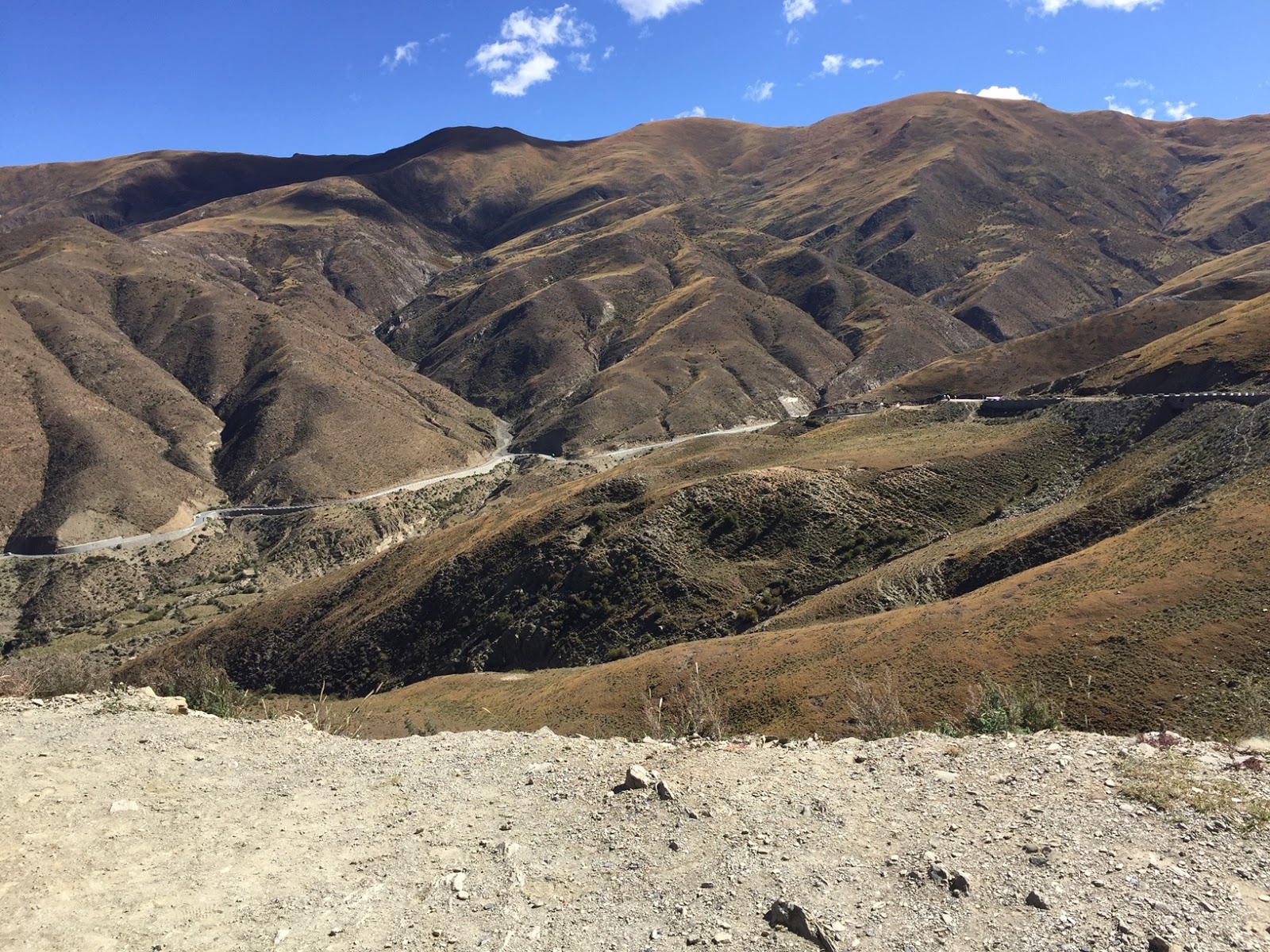
Pictures of scenery never look as good as the real thing, but here are a few more as I leave Tibet.  The first shows the road that we drove on over the pass.


Wednesday, October 9, 2019

Yom Kippur in Tibet

After a week's vacation in Phuket, Thailand, and another weekend in Shanghai, I flew to Lhasa, Tibet - the rooftop of the world.  Lhasa is on a plain, surrounded by spectacular mountains, but the plain is at an elevation of nearly 12,000 feet.  Later in the week, I will be going to a lake at 15,000 feet, after climbing over a pass at 16,000 feet - higher than I have ever been.  But I already have a shechechiyanu for the new year:  for dinner I had a yak sandwich in a fried flatbread that was a cross between a pita and a tortilla.


Appropriately, I am staying in the Shangri La Hotel.


Built onto a mountain in the middle of Lhasa is the Potala Palace, the home of the Dalai Lamas.  My guidebook said not to visit it on your first day in Lhasa since you need to acclimate to the altitude, but apparently my guide had not read the book.  So there I was on my first morning in Tibet climbing all 365 steps - very slowly with lots of rest stops - to visit this 1000 room palace.  There are still monks living in it, but it houses the tombs of the previous Dalai Lamas and more Buddhas than I could count.  Ornate does not begin to describe the inside of the palace.  That is not a person in the second picture but a robe to represent one of the Dalai Lamas.  There were about ten of them scattered about so I could not keep them straight.


Image result for potala palace

Image result for potala palace

Then we went to the Jokhang Temple, the spiritual heart of Tibet, which houses a 2,500 hundred year old statue of Buddha.  I had visited several temples and shrines in China, but nothing had prepared me for this.  In China, religion is mostly dead, but not so in Tibet.  A parade of pilgrims walks continuously around the temple.  The pilgrims are almost all Tibetan, either locals or from the surrounding countryside.  Some hold beads, some hold prayer wheels, and most chant softly.  This parade, called a kora, goes on all day, every day, and the pilgrims do not just walk around once.  They might walk around ten or twenty times before approaching the temple.

When the pilgrims finally approach the temple, they prostrate themselves - again not once but dozens or hundreds of times.  Each one has a narrow mat about the size of a yoga mat.  Most wear kneepads and they have pads under their palms that are cloth on top but slippery plastic on the bottom.  Each person stands and puts his hands over his head, then chest level.  Then he kneels and pushes forward on the pads to prostrate himself.  Then he pushes back up and repeats.  And repeats.  And repeats.


A few people were sitting at the back chanting prayers from books.


After parading and prostrating, the pilgrims then stand in a long queue to walk through the temple to see the many Buddhas and, in particular, the 2,500 year old Buddha.  Visiting Jokhang Temple was a very interesting activity for me on the day before Yom Kippur.  It is kind of amazing how many similarities there are in religious practice:  bowing and prostration, parades of pilgrims, chanting prayers.  Also, Buddhist holy books are placed inside prayer wheels (that look a lot like Sephardi torah covers), and the Tibetans spin the wheels to symbolically read the books.


The second story of the Jokhang Temple:


In the afternoon I went to the park opposite the Potala Palace to enjoy the view.  I thought the workmen were taking down the backdrop from the National Day celebration last week.


But when I came by later, I saw that there were not taking down the backdrop but putting it up along with a set of signs.


Really?  The Trans-Himalayan International Extreme Cycling Race?  How far trans do they go?  This is beyond extreme.

On Yom Kippur my religious education continued with visits to Norbulingka (the summer palace of the Dalai Lamas), another shrine, and the Sera Monastery.  I had not realized it before but the koras (parades) are not limited to Jokhang Temple.  In the morning we saw koras around Potala Palace and longer ones around the city.  I kept asking my guide how all these people could walk all day.  Don't they have to work?  And while there were some young people, the vast majority are older.  My guide shrugged and said:  so if they are not Buddhists, at least they get exercise.


Although it was built in the 1950's, Norbulingka has the same ornate decor as the Potala Palace.  I guess the Dalai Lama wanted to feel at home.  One of the more unusual sights at Norbulingka:  three horned goats.  I'm not clear on the name since many of them had four horns.


The shrine that we went to had more people prostrating themselves including children and this boy, about 15 years old, who prostrated himself on each step going down.


Besides prostrating and turning prayer wheels, the people burn candles made of yak butter traditionally but maybe just regular butter today.  In this cave, people brought packages of yak butter and a donation and the workers there keep 10,000 candles burning.


Finally the Sera Monastery houses 600 monks, down from its glory days of over 5,000 monks.  Anyone can be a monk which involves studying all day.  After ten years or more, if you pass a test, you can become a lama.  At Sera Monastery, they have a "debate" every afternoon at 3 that is open to the public in which the monks discuss theology and philosophy.  There is also a Buddha here that the people line up to bow to.  They bring their small children with them and a monk puts a smudge from the yak butter burning lamp on each child's nose.  This makes the children sleep better, behave better, and seems to cure all illnesses, too.

Unfortunately, or maybe fortunately, the debate was cancelled today and I got to see an unusual event.  Hundreds, maybe thousands, of people were painting and whitewashing the monastery using the most primitive methods that I could imagine.  The people, who are all volunteers, ranged in age from teenagers to the elderly.  The white wash was mixed in huge vats by combining crushed white rocks with water and minerals  Everything was carried up the mountain (the monastery is on the side of a mountain) by hand - one sack of sand, one pail of water - at a time.  Then people would take a bucket of the mixture and throw it at the walls.  Whitewash was everywhere - on the walls, the windows, the ground, the volunteers' clothes.  I saw a few monks giving directions but mostly it seemed like organized bedlam ... and everyone seemed very happy.


In the last picture, the man in the makeshift sling is painting the window trim black with real paint.  I guess that is why they can throw the whitewash everywhere.

Lunch at the monastery was yak noodle soup and milk tea and all of the painters took breaks to eat.


I saw very few face masks in China as the air quality was fine, but a lot of people wear them here, not just the painters.  The air is mountain clear here, but apparently, people wear face masks because of the wind and cold, and after a while it just becomes a habit.  Most people wear western clothes, but a few of the women wear modified traditional clothes - a striped apron over a long skirt.


By the way, it is fine to take pictures of people here, even in religious practice, and people take my picture, too.  But you are absolutely forbidden to take pictures of the police, military, or any police or military vehicles.

I had a long discussion with my guide about heaven and hell, buddhas and gods.  I could not understand the relationship between buddhas and gods, and that Dantean ghost city I had gone to in Fengdu made the Buddhist and Christian heaven and hell sound very similar.  But according to my guide, the gods (God?) and heaven and hell are all part of the same cycle.  Even when you go to (Buddhist) heaven or hell, you are still reincarnated, although I was not clear on when.  Only when you break the cycle and become enlightened do you become a buddha.  It is not that Buddha is higher or lower than a god; Buddha is completely outside the cycle of man, gods, heaven, and hell.

My guide used the word karma in the popular sense that Jews use the word mitzvah.  I kept asking why people did things like a kora or prostration and he said it was to get karma.  One kora might get you one karma but on a holy day it might get you ten, so more people did koras on holy days.  Oh.  Also, he explained that there are two types of Buddhism.  I can't remember their names but Tibetan Buddhism focuses on the betterment and enlightenment of all sentient beings while in the other Buddhism, individuals seek enlightenment.  Needless to say, Tibetan Buddhism is a higher level.

So back to my Yom Kippur musings ... The Potala Palace reminded me a lot of the Church of the Holy Sepulchre forty years ago before it became so commercialized.  You could just wander around the various rooms, all incredibly ornate with incense and figurines everywhere.  The neighborhoods around the shrines in Lhasa reminded me of the Old City of Jerusalem, again forty years ago.  There are pilgrims here but virtually no tourists, so the shops cater to the pilgrims.

The Buddhists carry prayer beads; sure look like rosaries.  The monks study books in monasteries and can become lamas; sure sounds like studying for smichah in a yeshiva.  A smudge on a child's nose; sounds like Ash Wednesday.  The koras (parades):  I happened to be at the Chartres cathedral several years ago watching thousands of Frenchmen complete a three day pilgrimage from Paris.  Not to mention the hajj to Mecca and Jews visiting the Kotel.  The Buddhists have a million buddhas that I can't keep straight and people pray to different buddhas; hmmm ... sounds a lot like the Catholic saints that I can't keep straight.  Why do you put your palms together fingers up to pray in so many religions?  Why do people in all religions prostrate themselves?  Of course the Buddhists and the Moslems, but also the Jews saying aleinu today.  Every religion that I know has one or more holy books and people chant from them.  Buddhism has a lot of holy places like holy mountains and holy lakes.  I can't quite wrap my mind around the concept, but is it different from a Catholic shrine or the kabba or the kotel?

So, very appropriately I think, I spent Yom Kippur contemplating religious practice and theology.  At one point, and I can't even remember how we got there, my guide agreed that many religious practices are very similar.  The only thing that matters, he said, is compassion.  I can't argue with that.