Sunday, October 8, 2017

Back on safari

We crossed the border from Zambia to Zimbabwe on the original 1905 bridge ordered by Cecil Rhodes.  It is one of the few bridges in the world that accommodates railroad, cars, and pedestrians.  The car lane is just that - one lane.

Two thirds of Victoria Falls is in Zimbabwe, and that portion has water year round.  We walked the length of the Zimbabwe side, and even in the dry season, you can see and hear the smoke that thunders.


Although we were across the gorge from the falls, we could feel a little mist when we started our walk.  After a while, however, it started to rain ... except that it was not rain.  So much mist comes across the gorge and settles on the trees, that it creates its own mini-climate zone - a tropical rain forest where it is always raining.  When the falls are full, you have to wear a raincoat just to walk on the far side, and you cannot see the bottom of the falls because the mist rises so high.


After we left Victoria Falls, we drove on to Botswana where we are staying next to the Chobe National Park.  In the afternoon, we took our first game drive - a boat ride down the Chobe River.  Once again, it was peaceful as different kinds of antelope grazed, elephants walked by, hippos stood in the water with just their noses showing, and the occasional crocodile lay in the sun.


In the morning we went on a game drive in the park.  Two lionesses walked across the road in front of us, but the highlight was a huge herd of elephants that surrounded our vehicle - adults, adolescents, and little babies.  The guide did not seem concerned that the elephants were so near to us, maybe because we were in a vehicle this time.  We just sat and watched the elephants.  We also saw lots of antelopes, warthogs up close and personal, two giraffes, and a small group of zebras.


Mostly we have seen these animals standing and grazing.  Or in the case of the warthogs, kneeling and grazing.  But when the day became hotter, the antelope all sat in the shade where they chewed their cud, digesting all of the food they had eaten.  We watched the kudus chew and could see the food go down their throats.  They would stop chewing and a few seconds later, we could see something go up their throats.  Then they would chew again and keep repeating the process.  Fascinating.


In the afternoon we had a few hours free until our evening game drive so I went to my natural habitat - poolside - to read for a while.  Bushback antelopes, mongooses, and baboons wander freely on the grounds of our resort, but I looked up from reading when I heard a splash and saw two baboons enjoying the pool.  Then one climbed into a pool chair.


A few corrections and addenda to previous posts ...

First, when David Livingstone died, his two African attendants, Sussi and Chuma, buried his heart in Africa.  Then they somehow embalmed him and carried him one thousand miles to the coast in Tanganyika where, according to the guide, they "pickled" him again.  His body was brought back to England and he was buried in Explorer's Corner in Westminster Abbey, but his heart remains in Africa.  Interesting because by the end, the British did not like Livingstone very much.  He started out as a poor Scottish boy and became a world famous explorer, perhaps the best known of the nineteenth century.  But he spent his last thirty years as an advocate against African slavery, making him very unpopular with the British colonialists.

Cecil Rhodes, on the other hand, had no such scruples.  And he certainly had no business scruples.  At the De Beers annual meeting in May 1887, Rhodes declared that amalgamation would enable the diamond industry to gain the position it ought to occupy, "that is, not at the mercy of the buyers, but the buyers under the control of the producers."  What a nice guy.


Friday, October 6, 2017

Two days in Zambia

We are staying near Livingstone, Zambia in Sanctuary Sussi Chuma which is named for the two natives (Sussi and Chuma) who attended David Livingstone during his explorations in Africa.  When Livingstone died in modern day Zambia, Sussi and Chuma carried his body hundreds of miles to the coast in Tanganyika to turn it over to British authorities who then brought it back to England for burial.  The Sanctuary is located in Mosi-oa-tunya National Park about ten miles upstream from Mosi-oa-tunya which means Smoke that Thunders.  Livingstone could not pronounce Mosi-oa-tunya, so he named the falls after his queen; hence Victoria Falls.

Our first game drive yesterday was through the park which houses most of the surviving white rhinos in Zambia.  Another fun fact:  white rhinos are not white and black rhinos are not black; they are all grayish.  White rhinos have a wide mouth, but people heard "wide" rhino as "white" rhino.  Then they named the other subspecies "black" rhinos to distinguish them.  Viewing a rhino mother and baby with our guards:


This morning we got our first look at Victoria Falls which lies on the border of Zambia and Zimbabwe.  There is a bridge over the river connecting the two countries that was completed in 1905, three years after Cecil Rhodes died.  Rhodes had ordered the construction of the bridge as part of his plan to conquer all of Africa for Britain and build a railroad from Capetown to Cairo.  For miles as we approached the falls we saw large trucks carrying copper parked by the side of the road.  Only one truck at a time is allowed over the bridge, so they line up for days to get across.  It reminded me of the boats lined up outside the Panama Canal waiting to cross.  At the time the bridge was built, it was the highest bridge in the world.
Image result for victoria falls bridge

It is the end of the dry season, so the falls are a fraction of the wet season peak.  We stayed on the Zambian side which is mostly dry now.  At the height of the rainy season, you cannot see the falls because the spray rises over four hundred feet and you need to wear a raincoat just to get close.

Image result for victoria falls
Dry season
Image result for victoria falls
Rainy season
After viewing the falls, we visited the local village of Nakatindi, where we were given a tour of the school, the health clinic, and a local women's business - refurbishing and selling bicycles donated from America and England.  The children followed us through the village, holding our hands.


Someone on my Kenya safari had told me that the helicopter ride over the Falls was the highlight of her visit, so off I went.  She did not steer me wrong.  It was amazing.  First we flew into the gorge and "rode" the rapids.  That was the coolest thing.  I swear we were in the water at times and crashed into the rocks.  The pilot angled the helicopter as we made turns so it really felt like we were riding the rapids.


Then we flew over the Falls for an excellent view of the "dry" falls and the land that would be flooded in rainy season.


Finally, we did a quick game ride, spotting elephants and hippos from the air.  It was an incredible experience.

On the way to the helicopter center, I had noticed a sign pointing to the Jewish Museum.  Really? I asked my guide.  There is a Jewish Museum here?  Yes, he said.  It is part of the Railroad Museum.  Of course.  So after the helicopter ride, I asked him to take me to the Jewish Museum.   This tiny museum in the middle of nowhere was just fascinating.  Most of the Jews who got out of eastern Europe in the late nineteenth and early twentieth century went to the United States when it had open immigration, and some went to Palestine.  It is fascinating to me how others who could not get visas ended up in the oddest places.  Like the Jews of Capetown, the first Jews in Zambia (then Northern Rhodesia) came from Lithuania - more of my landsmen.  Many were peddlers who later became shopkeepers, and a few established some of the largest chains of stores in Zambia.

South Africa and Southern Rhodesia (modern day Zimbabwe) were anti-British for a long time and philosophically were German sympathizers, so in the 1930's they, like the US, passed anti-immigration laws.  But Zambia was one of the few countries in the world that had open immigration for the Jews escaping Germany and Eastern Europe.  So Zambia had a small but vibrant Jewish community from approximately 1880 until the 1960's when Zambia won its independence and all of the whites left.  Who knew?

The guide at the museum insisted on walking me through the railroad museum although I had no interest in it.  (Sorry, Joe.)  I finally got the connection, however.  Two prominent Jewish families owned the sawmill that prospered when they were building all those railway cars, and eventually, they bought shares in the railroad company itself.

When I signed the guestbook upon leaving the museum, I saw that I was the first visitor that day.  (It was after 2 pm) and there had been five visitors the previous days.  A Jewish museum in the middle of nowhere in Livingstone, Zambia is not a hot attraction?  Go figure.

Our afternoon activity was a game boat ride down the Zambezi River.  We rode a few rapids but stopped well short of the falls.  Oh, darn.  We saw a lot of hippos and a crocodile in the river.  Then we stopped for cocktails and appetizers set up for us on the riverbank.  We were having a delightful time watching the peaceful river when we were visited by a heard of elephants.  At first we watched them through our binoculars.  Then without binoculars.  Then our guides started getting very nervous and told us to return to the boats.  The lead male elephant was flapping his ears at us which apparently is not a good thing.  So we rode the boats back up the rapids for sundowners and dinner at the Sanctuary.  The walkways are raised at the Sanctuary to accommodate the warthogs, antelopes, and occasional elephants that stroll by.  But we share the grounds with dozens of baboons.


This has been a lovely beginning to the Botswana safari.


Thursday, October 5, 2017

Final final South African experience

We flew to Livingstone, Zambia, today where it is 95 degrees and I am finally comfortable after two weeks of cold and rain in South Africa.  I have a lovely private bungalow overlooking the Zambezi River.  In a few minutes we are going for a game drive and tomorrow we will visit Victoria Falls.


But I forgot to write one interesting experience that I had on my last day in Capetown.  I was standing outside the central Dutch Reform Church, about to go in and see a sculpture that two of the guides had talked about.  The Afrikaaners call the Dutch Reform Church the Mother Church and they call Capetown the Mother City.

All of a sudden, I heard a loud commotion from around the corner.  Then I saw a man sprinting around the corner with another man chasing him.  Right in front of me, the second man tackled the first who, as he went down, threw a cel phone under the car that was parked there.  Then a huge crowd came around the corner and surrounded the man on the ground, kicking and hitting him.  At least one person in the crowd was carrying a metal tire iron.  The man on the ground kept asking:  What I do?  What I do? and showing his empty hands.  Since I had seen him throw the cel phone under the car, it was not hard to figure out what he do.

Immediately, before the crowd could really attack the man, I heard a siren and a police van tore around the corner and stopped.  It all happened so fast that I am not sure, but I think that the first chaser may have been in a uniform and may have been a policeman.  I can't think how the police car could have gotten there so fast otherwise.  The chaser retrieved the cel phone from under the car, the man was put in the back of the police van, and a woman got into the front seat of the police car.  I assume it was her cel phone that had been stolen.  The police van drove away and the whole thing was over in less than three minutes.  Pretty impressive justice South African style.


More food for thought ... the only two countries in the world to have mandated segregation - making segregation mandatory and integration illegal - are South Africa and the United States.

And now on to a waterfall and more animals.


Wednesday, October 4, 2017

Final random thoughts on South Africa

There are eleven official languages in South Africa.  The most spoken is Zulu followed by Afrikaans, English, and xhosa.  English is the language of business, but all of the whites that I have met, including my guides, seem to speak Africaans as their first language.  Even when they are making arrangements right in front of us, our guides speak Afrikaans to each other. All of the blacks speak one or two native languages, English, and Afrikaans.  It is very impressive that most people are at least trilingual.

Total aside ... someone who speaks three languages is trilingual. Someone who speaks two languages is bilingual. Do you know what they call someone who speaks one language? American.

What the British proconsul Sir Garnet Wolseley thought of the Boers in 1879:

A Boer's idea of life is, that he should pay no taxes of any sort or kind, that he should be amenable to no sort of law he disliked, that there should be no police to keep order, that he should be allowed to kill or punish the Natives as he thought fit, that no progress towards civilization should be attempted, that all foreigners should be kept out of the country & that he should be surrounded by a waste of land many miles of extent each way which he called his farm, in fact that he should have no neighbours as the smoke of another man's fire was an abomination to him. These Transvaal Boers are the only white race I know of that has steadily been going back towards barbarism. They seem to be influenced by some savage instinct which causes them to fly from civilization ... Altogether I regard them as the lowest in the scale of white men & to be also the very most interesting people I have ever known or studied.

Oh, and when the Boer dissidents held a mass meeting that Wolseley had banned, they marched with their Confederate flag. Whoops, I mean the Vierkleur, the Transvaal flag.

It turns out, not surprisingly, that language is always politics. The Afrikaans language is a bastardization of Dutch and zulu that was invented so the Afrikaans could thumb their noses at the British who ruled them.

It also turns out that, while there are no good Europeans in the history of South Africa, the Dutch Boers were way worse than the British who tried to be fair - sorta - and made treaties with the local tribes that they had no power to enforce when the Boers ignored the treaties and invaded native land. It is really hard to make the British colonialists look good, but the Boers managed to do it.

It also turns out that Cecil Rhodes was definitely a product of his time as well as an unscrupulous businessman. He said:

I contend that we are the first race in the world, and that the more of the world we inhabit the better it is for the human race. I contend that every acre added to our territory means the birth of more of the English race who otherwise would not be brought into existence. Added to which the absorption of the greater portion of the world under our rule simply means the end of all wars. (GRC: clearly we are not counting the wars while that "absorption" was going on.)

He pledged himself to work for: "The furtherance of the British Empire, for the bringing of the whole uncivilised world under British rule, for the recovery of the United States, for the making of the Anglo-Saxon race into one Empire." He was particularly exercised by the "loss" of the United States, blaming it on "two or three ignorant pig-headed statesmen" in the eighteenth century. "Do you ever feel mad, do you ever feel murderous? I think I do with these men." Nevertheless, there was Africa. "Africa is still lying ready for us and it is our duty to take it ... more territory simply means more of the Anglo-Saxon race, more of the best, the most human, most honourable race the world possesses."

This afternoon I flew to Johannesburg to join my next safari. We are leaving early in the morning for Victoria Falls, but we are staying today in an incredibly luxurious hotel. Gated of course, so I am sitting at poolside once again and have seen nothing of Johannesburg. I am staying in a villa with a few rooms, not the main building, and our villa has our own butler. I don't know that I have ever had a butler before. Maybe the British got some things right.


Return to Capetown

I spent ten days cycling through the Western Cape where I saw a lot of beautiful places and ate a lot of good food, but I did not feel that I had seen South Africa.  My two white guides said several things that troubled me, but although I am in the middle of a good South African history book,  I did not have enough context or historical background to know if they were representative.  Examples:

In the beginning of time when the Dutch first came here … (Really? What about the people who were already here?)

The day that we had Portuguese food, the guides mused: The Portuguese got here first, of course.  I wonder what our country would be like if the Portuguese had settled here rather than the Dutch later.  We’d probably be like Mozambique.  (But they didn't consider what the country would be like if the Dutch, and later the English, had not taken all the land and disenfranchised the natives. It was only the second day of the tour and I decided not to ask.)

The Zulu came down from the north.  They weren’t native to the Cape area.  Also the xhosa.  The natives in the Cape were the khoisan, but they were very peaceful.  They wouldn’t fight.  They just went away.  That is why they were no good as slaves.  So they brought in slaves from Malaysia, and later from India.  That is how it is.  You have to bring slaves from somewhere else or they will just run away.  So in America they brought slaves from Africa and here we brought slaves from Malaysia and India. (This one is a mouthful. Naturally, you must import slaves. Naturally. But this also states a very important Afrikaaner trope that they didn't take the land from anyone because no one was here - a land without a people for a people without a land. There is an element of truth in this trope. When diamonds and gold were discovered near Johannesburg, there was a great need for cheap labor that the Europeans were not willing or able to do. And since natives were displaced from their lands all over Africa, many natives of other countries came voluntarily to South Africa to work, and then ended up effectively enslaved. This seems to give the Afrikaaners continuing superior claim to the land.)

When I asked what people think about Nelson Mandela:  He was the best president that we have had.  He brought everyone together.  It could have been a big fight.  We thought there might be a civil war and that would have been bad because there are lots more of them than us. (No comment necessary.)

There seem to be protests and even riots on a fairly regular basis, but when I asked the guides what the protests were about, I got very evasive answers:  Oh, they want things faster or they want more.  So they think it is a good idea to burn down what they already have.  They complained about the bus service so they burned the buses.  What sense does that make?  Of course, it is only a few troublemakers. (That clarifies who the "they" is.)

One of the guides is a serious marathoner and triathlete. She told us about a big annual race that got canceled for first time ever because of weather: They handled it very well. They told everyone that was registered that they would have first priority for next year’s race at this year's registration fee.  But they had so much food and supplies already prepared so they gave it to an organization to help poor people.  So my money went to them. (This doesn't do justice to her tone of voice. She mentioned a specific organization that received the largesse and she was clearly not happy about her race money going to "them.")

After my bike trip got over, I had two and a half days in Capetown and I made the most of it.  The first afternoon I took a historic walking tour of the central area.  The guide did a great job of explaining the growth of Capetown and the central role of slavery.  As my bike guide had said, the slaves were not originally Africans; they were primarily from Malaysia and India, although later the British brought slaves from Western Africa.  The guide was very clear, however, that the slaves built the beautiful city that Capetown is today, not the Dutch or English who take credit for it.

The next day I took a bike tour of the city of Capetown, covering a lot of the same ground but getting into some other neighborhoods out of the downtown area.  I was not wearing my Claremonster bike shorts, so this is not an official picture.


The bike tour started from the upscale and touristy Victoria and Albert waterfront area where there are bridges over the shipping lanes.  I had to wait for this pedestrian swing bridge that was closing after a boat passed.


I picked a perfect day for a bike ride as it was finally sunny and warm.  I considered taking the cable car up Table Mountain after the ride since it was such a nice day, but in the afternoon, it started to get colder and windy so I hesitated.  First I went to the Slave Museum, and then finally decided that a trip up Table Mountain was a must when in Capetown.  Wrong decision.  I grabbed a cab to the cable car station, only to discover that the cable car had stopped running because it was too windy on the top.  Duh.  So I grabbed a cab back but by then it was too late to do anything else.

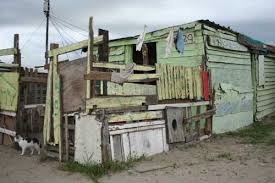
On my last morning in Capetown I took a township tour.  Part of what has bothered me has been the obvious discrepancy in living conditions.  The whites live in beautiful, well maintained single houses with electric gates and barbed wire.  You can see the townships clearly on the outskirts of every city and they look like shantytowns.  Also, most of the drivers I see are white and the local buses seem to be used only by blacks.  The "buses" are privately owned white vans that go on regular routes known only to the regulars.  One of my white guides said she had never been on one and would not go on one.  That was a challenge to me and I wanted to take one, but couldn't figure out how or where.

Image result for south african townships

Image result for south african townships

We visited Langa, one of the oldest townships in the Capetown area.  Our guide, whose name I simply cannot pronounce, was born in Langa, but his family bought a house in a mixed neighborhood after apartheid ended and he went to a private school.  He has a university degree in landscaping, and he decided to move back into Langa.

Langa has U-shaped buildings that were originally dormitories for men with common bathrooms in separate outbuildings.  The men worked for eleven months of the year and went home to visit their wives in December.  So most babies were born in September.  Duh.  Later, when women were allowed into the townships, the dormitories were remodeled into separate rooms for each family, still with communal bathrooms and cooking facilities.  The government is building new housing but not fast enough to keep up with the demand, so they are using shipping containers as temporary housing.  We met with one older woman who lived in half a shipping container with a refrigerator and hot plate.  (There is electricity but of course no running water in the rooms.)  It was another cold, windy day, and she was in bed fully dressed and under a blanket when she talked to us.  Needless to say, the shipping container is freezing in the winter and hot in the summer.  She has been in her temporary housing for nine years.

A strip mall in Langa
Next we met with Shooter (Shorty) who prefers to be known as the Morgan Freeman of Langa.  He built his own two bedroom mansion with scrap materials, and when it burned down in 2013, he rebuilt it.  He invited eleven of us into his living room and bedroom (sit on the bed, it's okay, I'm single) and talked to us about life in Langa and his life before and after apartheid.

Shooter outside his house

Notice behind Shooter in his living room the TV, cable box (or VCR, not sure which), speaker, picture of his wife who passed away in 2010, and pictures taken with people who have visited him.  He really wants Morgan Freeman to visit him.

Shooter was incredibly optimistic and upbeat.  Echoing something I heard several more times, he said that the happiest day of his life was when he voted in South Africa's first democratic election in 1994.  People queued up for hours that day to vote.

After our visit with Shooter, we went to a local microbrewery.


Men sat around the fire while the owner made the .5 percent alcohol beer from a secret recipe passed down only to the women in a family.  The frothy mixture was in a single large can that was passed around the room.  The locals laughed at us for taking only small sips and showed us how you are supposed to drink.


Then we visited a local entrepreneur who ran a bakery cum catering business from her home which had at least three bedrooms that I saw and a bathroom with modern plumbing.  All of the houses on her street were detached, mostly with driveways and/or garages, and mostly with nice cars outside.  Our guide said that the first thing that people buy when they can afford to is a car, and one of the most popular businesses is a car wash since everyone washes their car every week.  Needless to say, these are not automatic car washes, but buckets of water applied by young boys with rags.  The bakery made a local flat roll similar to pita and they served us chicken salad sandwiches in warm bread.  Excellent.

Langa has elementary schools, high schools, a library (very important for room to study since the houses are so small), a medical center, and a sports complex.  It is spring break this week, so the children were all outside playing, but we saw three boys walk by with their backpacks on.  They were on their way to their math tutor, and as our guide said, small boys don't choose to be tutored in math, so clearly their parents were pushing them.

There were an assortment of shops including the usual grocery stores and beauty salons.  Also, a butcher that specialized in a local delicacy:  sheep's head.


Langa gave me a lot of food for thought.  Most of it still looks like a shanty town.  Living in a shipping container for years as a temporary placement.  One room for an entire family.  Bathrooms in separate buildings.  Getting up to shower at 2AM because the hot water will be gone by 7.  Communal kitchens.  Wires hanging down everywhere that are jerry rigged to provide electricity to the "temporary" containers or self-built houses.  But our guide chose to more back into Langa.  Shooter is one of the most contented people I have met.  Now that blacks are no longer forced to live in townships, is that enough for the people to take ownership and create community?  I have no answers.

Back in Capetown, I had the guide drop me at the District 6 Museum.  District 6 used to be the most (literally) colorful neighborhood in Capetown - a combination of the Lower East Side and Greenwich Village.  Immigrants such as the Eastern European Jews who came from Lithuania in the late nineteenth century moved into District 6.  Theater and music thrived in District 6.  During the Apartheid Era, District 6 was designated a coloured (as opposed to black) area.  But it was in a prime geographical location close to downtown, so beginning in the late 1960's the government bulldozed it, forcibly removing over 60,000 to the townships or further-out coloured districts.  In the 1990's a temporary exhibit to the former residents of District 6 was so popular, that it was made into a permanent museum.

The museum is fascinating, but the real story is that District 6 is still up in the air.  The government built a college on part of it and developers built on a little more, but most of the land is still undeveloped.  So who gets it?  There is a process for former residents to prove their ownership, but the records have been mostly destroyed, so few can do so.  Besides they are all old now.  Do their children get the property?  Who would have to pay to build on the property?  Do they get compensation instead?  The government and local activists have been struggling with this for years with no solution.  Bear in mind, however, that this is prime real estate close to downtown.  So who do you think is going to win in the end?

Next I took another walking tour called From Apartheid to Freedom.  This was mostly a two hour lecture given piecemeal at several locations by an excellent young guide.  His mother was mixed-race and his father was an immigrant from Czechoslavakia - a very interesting combination in South Africa.

During Apartheid, there was a four tiered system of classification:  whites, mixed race, Indian, and black (or zulu).  We stopped at the court which had to determine which class you belonged to.  Mixed race, or coloured, was a significant step above black.  Indian included everyone from Asia, so the Chinese, Japanese, and Malaysians were all classified as Indian.  Toward the end of the Apartheid era when virtually no country would trade with South Africa, the Japanese were willing to do so.  This created a problem for the government since Indians were not allowed to trade with whites.  So the government designated the Japanese as "honorary whites." 

By the 1980's, the government realized that the end of Apartheid was inevitable and worked on a smooth transition.  I had pictured de Clerk, the last  president of the National Party as George Wallace standing on the steps of the University of Alabama declaring, segregation today, segregation tomorrow, segregation forever.  But he was not.  He deserved the Noble Peace Prize that he shared with Nelson Mandela.  Under de Clerk, the ANC, which had been declared illegal was legitimized and political prisoners freed.  He worked with Mandela to transition to a democratic government, and served as deputy president under Mandela.

At least three different guides took me to the place where Mandela gave his first speech after being released from prison in 1990 and told me the same story.  It was a very hot summer day, and the speech was supposed to be given at noon.  The plaza could hold 100,000 people, but more than 250,000 squeezed in starting the day before.  But Mandela did not begin to speak until after 4 (after 8 according to one guide).  When he did, there was complete silence as he said, we must forgive them.  Not what the people or the ANC wanted to hear.  They wanted arms; they wanted a civil war.  But Mandela said, I can forgive them for putting me in prison for twenty seven years, so you can forgive them, too.  At the first democratic election four years later, that every single person remembers with great emotion, Mandela was elected president.  He advocated a two step process:  acknowledge the past and forgive.  You cannot just sweep the past under the rug; you have to first acknowledge what was done before there can be forgiveness.  Mandela certainly deserved his Nobel Peace Prize.

I had just enough time after this tour to visit the Jewish Museum which includes the old synagogue, the current synagogue, and the only Holocaust Memorial in all of Africa.  The old synagogue was nice and they had a very interesting exhibit about the early Jews in South Africa.  I thought they were German Jews who started coming in the 1930's, but it turns out that some Lithuanians came here starting in 1880, the same time as the great wave of immigration to the United States.  These are my landsmen.  But ... the current synagogue, which has an interesting architecture style and was what I really wanted to see, was closed by the time I got there.

Image result for capetown great synagogue

I was not planning on ever visiting Capetown again, but events have conspired against me.  I could not go up Table Mountain or visit the synagogue.  Is this a sign?  Who knows?