Monday, July 6, 2015

Nazca ... wow

The sun came out, the fog burned off, and they finally let the planes take off around 11.  The basic flight is half an hour over the Nazca lines, but there is a longer flight that goes over the Nazca and Palpas lines.  There was a minimum of two required for the longer flight so although I requested it, I wasn't sure if I would get it.  Fortunately, Rachel, a young woman from Great Britain who is traveling alone requested the longer flight just yesterday, and she was worried all night whether she would get it.  Obviously ... meant to be.

So while the other hundred people waiting got on "huge" six passenger planes, Rachel and I were escorted to a teeny tiny four seater.  Two pilots in the front (I liked that!); Rachel and me in the back.  It was amazing.

First of all, it was the smoothest ride.  I was a little concerned about the plane bumping around, but while it was noisy, it was a gentler ride than in a car.

Second, I was completely wrong about the terrain.  It is not all flat and dry.  In places where they use the underground water, it is green and lush.  And while much of the lines are on the flat  mesas, there were bare, rocky mountains, and some of the "drawings" were on the sides of the mountains.  Especially the Palpas lines which are even older than the Nazca lines and a little farther away.  They were smaller and mostly on the sides of mountains rather than carved into the ground.  I was glad I got to do the longer ride and see the Palpas lines, too.

Finally, the distances were much bigger than I had imagined.  It often took a few minutes between "drawings."  But the entire surface is marked with more than a thousand criss-crossing lines.  And besides the animals and people, there are huge trapezoidal "fields" that are scrubbed clear with rock borders.  They look like landing strips.

It was just amazing.  Even though I had seen pictures and watched the planetarium show, this is one of those things that you just have to see to believe.  It was well worth the fifteen hour round trip in a car to Nazca.

So, bearing in mind that pictures just don't do this justice ...

My view of the pilot
Looking out my window 
Image result for nazca lines
A perfect hummingbird
Image result for nazca lines
The astronaut on the side of a hill
Image result for nazca lines
Shapes on the ground
Image result for palpas lines
A Palpas family group on the side of a hill.
Image result for palpas lines
The Palpas star
That was it.  A one hour flight was not enough.  We had a long drive back to Lima, stopping for a view of the Nazca irrigation system.  They ran the underground water through channels accessed by wells.  But instead of building a deep well with a bucket dropped into it, they built spiral ramps down to the bottom of the wells.  Like the Inca walls in Cuzco and Macchu Picchu, the original Nazca walls have survived massive earthquakes and the water still flows in the original channels.

Image result for palpas lines

We also stopped in Pisco for a wine tour and tasting.  Pisco is the local alcohol and it is used to make a pisco sour, the national drink.

We arrived back in Lima in the evening where I will spend my last day in Peru.  Hasta luego.


From Cuzco to Nazca


My second week of Spanish school in Cuzco passed quickly.  My classmate was Michelle, the English teacher from Encina who randomly came to the same school as me.  We had classes every morning and in the afternoons, I walked around the city or visited one of the museums.  Walking was a challenge because the streets are so narrow as well as hilly.  A small car can barely fit between the buildings on either side of the street and sidewalks are rarely big enough for two people to walk together or pass each other.  You can't step into the street to pass someone if a car is coming, and even walking on the narrow sidewalks, you are in grave danger of being taken out by the side mirror of a passing van.  Also, the streets are one lane but sometimes two directions.  I would not want to drive here.  The local market has rows for each type of food:  produce, meat, cheese, bread, etc.  This is how you can tell the pork section.


For my last few days in Peru, I had scheduled a three day trip from Lima to the Nazca lines.  My one hour flight from Cuzco to Lima was supposed to leave at 11 Saturday morning, but Lima was fogged in and the planes could not leave to come to Cuzco.  I finally arrived four hours late and was happy I had booked a private guide.  It was nice to walk off the plane so late and see a sign with my name on it.
We drove south on the Pan American Highway for several hours to Paracas, a nature preserve which includes a peninsula, small islands, and the ocean itself.  Lima is like San Francisco: always temperate in climate and usually foggy or cloudy.  But as you drive south, the sun comes out and the land becomes drier and drier.  The Humboldt Current comes up the coast from Antarctica.  If I understood correctly (unlikely), cold water carries more oxygen than warm water, so as it goes north, the water can't condense, so it never rains.  Sounds odd to me but the bottom line is, it never rains.  They get less than 2 millimeters of rain a year here.  So it is bare and sandy land, with frequent wind storms.

Nonetheless, Paracas is incredibly biodiverse.  The water is full of anchovies which are at the bottom of the food chain, so there are lots of fish and larger marine animals.  Paracas is on the migratory route for birds in the Western Hemisphere and also has a large population of native birds.  We took a boat ride out to the islands which are protected because they are a major source of guano.  Dolphins swam alongside us, and on the islands we saw Humboldt penguins, sea lions, and lots of birds.  The Peruvians consider Paracas to be be their little Galapagos.  On the way, we saw our first Nazca lines - a figure that is probably a cactus but is called the Candelabra.  It is huge - on the side of a large hill.

Image result for paracas


Image result for paracas

It's hard to take pictures of birds and small penguins.

The next stop on the way to Nazca was the oasis at Ica.  Again, two millimeters a year of rain.  For some reason there is water underground in some places.  But otherwise, this is the bleakest land that you can imagine.  Nothing grows.  It is not even scrub land.  Just miles and miles of sand and rock.  So if you have lemons, you make ... a sand resort.  We drove in dune buggies up and down the sand dunes.  It was like being on a roller coaster.  We would go up an impossibly steep dune, go over the crest, and drop straight down.  I was in the front seat and it was a white knuckle ride.  Then we stopped at the top of a dune and they gave us boards to go down on.  The first slope was intermediate.  A little scary but I did it.  The second was a baby slope.  Piece of cake.  Then we stopped on top of a black diamond hill.  Straight down.  I got on and the guide gave me a little push, but I looked down the hill and bailed at the last second.  Call me a wuss.


 Finally it was on to Nazca for the main event.  The Nazcas predate the Incas by 1,000 years or more.  The area they lived in is completely flat - like a huge mesa - and it never rains here either.  Complete desert.  So for some reason that no one knows, the Nazcas etched out lines and figures in the earth.  And because of the unique climate and topography, the lines never go away.  And ... you can really only see them from the sky.  The lines were unknown for centuries until commercial flights started to fly over the land in the 1920's.  Of course one theory is that these were really made by ET's.  Why else have figures that can only be seen from the sky?  Another theory is that the lines were for the gods.  Some of the lines line up with sunrise or sunset on the winter or summer solstice, so they apparently knew something about astronomy.

We stopped at a tower and a small hill and I got my first view of some simple lines and forms.  Then I went to a fascinating planetarium show last night that focused on the lines but also a little about the southern skies.  A few days ago I realized that even though I go south every winter to warm weather, this is the first time that I have been south of the Equator.  I'm glad I wasn't a seaman on a ship having to undergo a hazing ritual.  I also realized that I had neglected to look up at night and see the Southern Cross for the first time.  So the planetarium show was perfect.  The guide took us outside first and pointed out constellations including the Southern Cross and the Big Dipper which is very low on the horizon here.  Also, Alpha Centauri, the closest star to the earth is visible in the Southern Hemisphere.  He pointed out three planets in the sky and later set up a telescope so we could see Saturn with its ring and even some of its satellites.

And now I am at the airport in Nazca waiting for my overflight.  It is grey and a bit foggy this morning.  All of the flights are scheduled for 9 AM, but we are just sit around waiting until they say we can have a good view.  This is what I expect to see.

Image result for nazca lines
The monkey

Image result for nazca lines
The spider

Sunday, June 28, 2015

Wandering around Cusco and Chinchero

On Saturday I walked to the Feria de Huancara (Huancara Fair) not knowing exactly what it was but my teacher said it was interesting and non-touristy.  Turns out it is the local State Fair.  The two most popular meats in Peru are beef and lamb, so I was not surprised to see cows and lambs in the animal exhibit.  It was the first time, however, that I have ever watched llama and alpaca judging.


The next most popular meat in Peru is guinea pig.  They look really cute in the exhibit area - like rabbits without ears.  They look a little less cute on the plate.


Unlike the California State Fair, the food is not all fried.  It is far more likely to be grilled.


Also, as you can see in the llama judging pictures, Coca Cola is a sponsor of the Feria.  But Peru is one of the few countries in the world where Coke is not the leading soft drink seller.  The top seller in Peru is Inka Cola, which for some reason is bright yellow.  The color has turned me off from trying it.  It is a little hard to tell in this picture but the bottles of yellow liquid in the third cabinet are Inka Cola.


Other sights in Cusco on the walk home from the Feria ... old guys playing four on four futbol on concrete - referee and all.  The next team is warming up.


There are openings in the Peru-German preschool.


Most of the sellers in the markets are women and many have babies with them. This little girl is sitting safely in a cardboard box.


On Friday, another student and I had returned to Sacsaywaman, the Inca ruins on top of the hill where the Inti Raymi Festival had been held.  This time we were able to take a tour without the crowds.  The Inca ruins continue to amaze, but one thing left me shaking my head.  According to our guide, the Cristo Blanco was a gift to the city of Cusco from Christian Palestinian refuges after the war in 1945.  I corrected him; there weren't refuges until 1948.  I confused him but he said the refuges came in 1945.  I went home and did what I do every time I don't understand something I saw:  I googled it.  Damned if Google doesn't agree with the guide.  Go figure.

Image result for cusco cristo blanco

On Sunday I returned to Chinchero, the first place I visited in the Sacred Valley, although Chinchero is not really in the Sacred Valley but on the way.  At an elevation of 12,000 feet, it is the highest point I have visited.  Chinchero is known for its native weavers.  On Sunday it has an artisanal and local market.  I took the collectivo to Chinchero like the locals do.  The vans won't leave until every seat is taken, but the price is only a dollar or two.

 After wandering through the market, I walked up the hill (stopping every fifty feet to breathe) to the Inca ruins on the top.  It was a beautiful day and I decided to sit in the grassy area and read.  But I saw one of the strangest sights I have ever seen.  Spread all over the grass were small ... potatoes.  Some were gathered into piles and the woman with the teal shirt is stomping them with her feet.  I asked her what she was doing and - maybe there is something wrong with my Spanish - but I thought she said she was mashing the potatoes to make ice cream tonight.  I cannot think of anything less appetizing than potato ice cream.  I must have heard wrong.  Although I was sitting more than fifty feet from her, I could smell the mashed potatoes.


It is really hard to see landscapes in pictures, but this was my view over the fields on the right to the snow capped mountains in the distance.


I watched another demonstration of dying and weaving in a woman's collective.  The woman on the right has a baby on her back and that is a little girl in the middle helping.


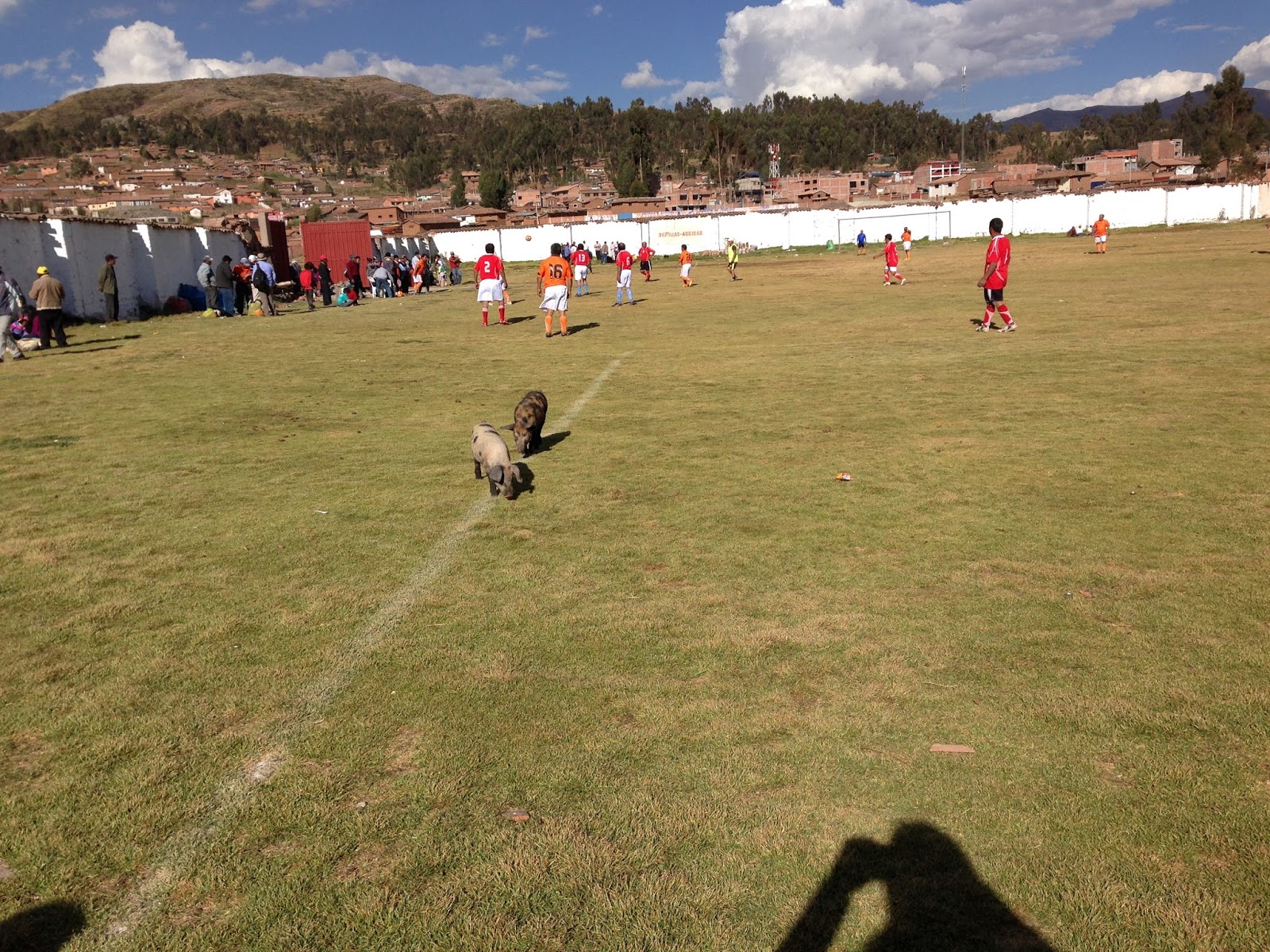
From my viewpoint at the Inca ruins, I could see the entire town and saw that there was a football game going on in the stadium.  So I walked over to watch the Sunday afternoon entertainment.  On a small field outside the main stadium the old guys were playing - eight on eight this time.  They were really bad and the crowd kept laughing every time one of them fell down.


Then I watched the main event in the stadium along with most of the town.  That is barbed wire on the fence between the stands and the field.  I didn't think the boys (or young men) played very well and thought my Encina boys could beat them.  Then I realized that at 12,000 feet, none of my boys would be running or breathing after five minutes.


Walking back around the old guys' field, I saw something else I had never seen before.  Is it a foul if one of the pigs takes out a player?


Back to Cuzco in the collectivo where I had sushi for dinner.  You can pretty much find anything in Cusco.