Wednesday, November 5, 2025

Yes, but is it art ?

I admit:  I lifted this title from a book about modern art that I read several years ago.

It took four train rides to get from Kanazawa to Takamatsu on the island of Kagawa.  Then today, we took a ferry to the smaller island of Naoshima which has been reborn as an art haven and is home to several museums of modern art as well as outdoor installations.  The most famous:  the red pumpkin and the yellow pumpkin by Yayoi Kusama.


First we visited the Chichu Art Museum which is built completely of concrete with narrow passageways.  It feels more like a prison than an art museum.  Chichu means "underground" which is where we were, with openings in the ceiling or walls to let in light.  There are only three rooms that exhibit art.  One has six large Monets including water lilies.  Incredible.  One had a rather odd installation, and the third was bare except for a pink light.  (Yes, I know it looks blue, but it was pink when I saw it.)


Okay.  Next, the world famous Benesse House Museum which opened in 1992 as a facility integrating a museum with a hotel, based on the concept of "coexistence of nature, art, and architecture. " Yes, that circle on the ground is made of pieces of wood.  The circles on the wall are finger (hand) painted with mud brought from the artist's home in Italy.

Finally, after lunch, the New Museum of Art.  There were some incredible (and incredibly bizarre) murals here, and this installation of "ninety nine lifelike wolves charging forward with fierce determination, colliding headlong in a glass wall without hesitation.  The wall, which is the same height as the Berlin Wall was, symbolizes the intangible yet deeply felt ideological and cultural divisions between people and communities.  The work reflects on the human condition:  our dangerous loyalty to dominant ideologies and our seeming fated cycle of error."

Yesterday we visited the Isama Noguchi Garden Museum.  Isama Noguchi is one the 20th century's most renowned sculptors, working primarily with granite.  He left specific instructions that after he died, all of the works in his house and garden should be left exactly where he had placed them.  Thus, a garden of granite pieces.


The day before, I created my own art.  We visited a paper factory and each of us made a postcard.


And perhaps the finest work of art that I saw:  Ritsurin Koen, a vast 185 acre Japanese garden dating back to the 17th century.  It is not on the list of the top three Japanese gardens, perhaps because its location is so remote, but it was truly spectacular.


They do not call it bonsai unless the tree is in a pot, but it is amazing how they can shape a full grown tree.  The rocks at the bottom make this look like a tree on a turtle.


Our trip is called "A Taste of Japan," so besides art, we are eating interesting and different foods.  Yesterday we had lunch at the Nakano Udon School where we cooked our own udon (in the bowl on the left) in the little stove on the right.  We did finally have tempura.  I wasn't sure what was in the middle on the bottom.  The right side had teeny raw shrimp that were meant to be eaten raw.


Today we were served a bento box and had to guess what was in each little box.  Three scoops of rice on the diagonal.  Center right looked like fruit but the consensus was sweet potato.  Fried chicken thigh top center, and some kind of cooked fish bottom center.  Bottom right was string beans, and dessert, on the top left, was a macaron and a piece of green tea cake.

Tomorrow we are having lunch at a renowned sushi restaurant.  At least I'll be able to recognize what I am eating.


Sunday, November 2, 2025

Dying arts, gardens and zen

The theme of our visit to Kanazawa was dying arts (no pun intended).  At our first stop, the Gold Museum, the docent explained the entire process of making and applying gold leaf.   Gold bars are pressed into thin sheets about a millimeter thick.  Each gold sheet is placed between two sheets of a special paper made out of rice straw and mulberry fibers.  A stack of a thousand sheets is then continuously compressed until the gold is less than .0001 millimeters thick.  This is the gold leaf that is then used in various arts such as painting and pottery, and even sprinkled over food.  Why is this a dying art since there is a fair amount of gold in the world?  The process for making the paper takes a month and the supply of artisans who know how to make the paper is disappearing.  They have tried using carbon paper and something like onionskin, but the result is inferior.  So the world is running out of gold leaf.

In the afternoon, we visited National Treasure Suzanne Ross.  That is how she has listed but I don't know who decides that you are a National Treasure.   Suzanne is singlehandedly trying to keep the art of lacquering alive.  I learned last week at the museum in Shanghai that lacquer comes from the sap of the lacquer tree.  I had trouble believing that, but it is true.  Lacquer comes from the urushi tree which only grows in Japan and China (slightly different varieties.)  The process of gathering the sap is very slow as it takes twelve years for each tree to mature and then each tree produces about a cup of sap that must then be processed producing an even smaller amount.  Despite Susan's efforts, urushi forests are disappearing since no one can make enough money growing and taking care of the trees.  By the way, Susan moved to her current location outside Kanazawa after a large earthquake (followed by flooding and fire) in 2023 destroyed her previous home and studio where she had been for over thirty years.

We had another ten course banquet in the evening.  Every few minutes they bring us a small plate with three or four bites of something that is often completely unrecognizable.  We take a guess, then we take a bite, and we are still not sure what we are eating.  The variety of food beyond the sushi that Americans know is staggering.  And I don't think I have seen tempura at all.

The next day we visited a (restored) samurai house.  The samurai period lasted for centuries, and the samurai were not just fighters, and certainly were not ninjas.  Rather, there was a hierarchy of samurai from the shogun (leader) to low level functionaries.  The size and height of each person's house reflected the level of the samurai within that hierarchy.

The floor of each room is comprised of tatami mats, each about three by six feet.  To this day, the Japanese do not measure room size by square feet but rather the number of tatamis, such as a six tatami room or a ten tatami room (very large).  In such small houses and rooms, there is little furniture (thus sitting on the floor), and everything must serve several purposes.  No need for a dresser; a kimono is folded and stored in a box.

In the afternoon, we visited Kenroku-en which is officially one of the three greatest traditional gardens in Japan.  It is a beautiful and peaceful Japanese garden.  We happened to be there when the workers were installing these tent-like frames (along with reporters and cameramen from several stations who were covering the installation).  Why?  These tents protect the trees from the heavy snow that falls in the winter.


We made a quick visit to another restored house, this time a Geisha House, and learned a bit about the music and other talents of the Geisha girls.  The main attraction in the afternoon was the workshop of Toshioka Kosen at his Kutani Kosen Kiln.  Toshioka is a fifth generation pottery maker, one of the few remaining traditional pottery makers in the area.  He walked us through the several stages of making pottery, a process that takes several months and at least five firings.  At his workshop, they still use wood burning ovens.  He thought about switching to gas, but decided that the old way was still the best way.  

One of the most interesting things I learned at the museum in Tokyo last week ... when Japan opened to the West in the late nineteenth century, the Europeans were totally unimpressed with the beautiful pottery and lacquered bowls (it's just decorative art), and the painted screens and lacquered chests (it's just furniture.)  So Japan sent artists to study Western art.  The first artists used watercolors, creating images similar to painted screens.  Water color?  Western experts turned up their noses again.  Apparently, unless it is oil painting on canvas, it is not "fine art."

Today we drove from Kanazawa to Fukui where we visited the Eihei-ji Temple which was described as "a Soto-zen monastery built in 1244 for austere meditation."  Monks live here for a year, meditating and praying for world peace, apparently undaunted that their prayers have not (yet) been answered.  After a year's training, they return to their home temples where the practice of monking is quite profitable.  Our guide insisted that they all drive BMW's.  Monks in Japan also marry and have families.  Not quite the same as Christian or even Laotian Buddhist monks.

Next, the Ichijodani Asakura Clan Ruins are one of the few ancient ruins and reconstructions that we have seen, although these ruins are only from the sixteenth century.  There is a lot of destruction in Japan - from wars, earthquakes, and tsunamis - but the Japanese just keep rebuilding.  Also, buildings were traditionally made out of wood and are easily destroyed in an earthquake or war.  So there are surprisingly few ancient sites for such an ancient people.  For the most part, the only shrines are Shinto, not relics of times past.

And finally, we visited another lovely garden with a "mansion" on a lake.  But the original mansion burned to the ground in an air raid during WWII, so we were in a lovely reconstruction.


A few observations about Japan ...

We had parked directly across the street from the Gold Museum but had to walk to the light at the corner to cross the street.  The guide told us that no one jaywalks in Japan.  Imagine a country where you can say that no one jaywalks.  

Also, there are no garbage cans anywhere.  I don't want to litter, but when I finish my Coke Zero, there is no place to throw away the bottle.  When I asked the guide, she said that some people carry a garbage bag with them and throw it away when they get home.  The lack of garbage cans even extends to public bathrooms where there are no paper towels for drying your hands.  You have to carry a small hand towel with you.


Thursday, October 30, 2025

Tokyo in 2 days

 Tokyo is a HUGE modern city, mostly upscale from the parts I have seen although I am sure there is more.  Significantly destroyed by US firebombing in 1945, and mostly built from wood in the first place, we have seen disappointingly few "historical" areas.  Nonetheless ...

We started with a visit to a foundation that is maintaining the ancient art of woodblock art.  The artisan applies each color individually from the blocks that the carver has carved.  We watched her create four copies of the Great Wave at Kanazawa.


Of course, after the demonstration there were plenty of pieces to buy.  I would have bought a copy of the Great Wave that I had just seen her create, but that was for demonstration purposes only and would be destroyed.  Nothing so imperfect could leave the studio.  What a shame.

For lunch we went to a restaurant to have authentic Japanese pancakes with meat, fish, and vegetables.  I pictured something like a crepe with the fillings of our choice.  Instead, we were each given a bowl of ingredients including a raw egg.  We mixed it all together and cooked it on the grill at our table.  Seemed like more of an omelet than a pancake.  No complaints.  It was very good.

A visit to the National Museum and a walking tour completed our first day.


On the second day, we walked through the fish market, sampling goodies and buying sushi and sashimi for a picnic lunch.  We started with a breakfast of unrecognizable fish.  I think they were marinated but tasted nothing like ceviche.  Maybe they were smoked?  I'm trying everything (as long as it doesn't have potatoes in it.)  We watched the Sushi Princess slice the tuna for us that she had bought at the wholesale market earlier.  I mean earlier.  She gets up at 2:30 every morning to buy a single tuna which she sells over the course of the day.  And then does the same thing the next day.  Needless to say, the fresh sushi and sashimi lunch was REALLY good.  And as you can tell from the life-size picture ... I am smaller than a tuna.


In the afternoon, we visited the Meiji Shrine.  I have been studying Japanese history, so I now know that the "most important" shrine in Tokyo is dedicated to the Meiji Emperor from the late nineteenth century.  People come to pray, not to Buddha or Allah or God, but to an emperor?  Clearly I am missing something.  Maybe in a hundred years or so we will have a MAGA shrine in America where people can pray.  Makes sense, no?


Finally we finished our Tokyo trip with a short visit to the Ginza.

Quick factoid about Japan:  it has roughly one third the population of the US in an area the size of California.

Off today to Kanazawa.


Thursday, February 22, 2024

Butterflies

Ten hours in a car, two hours on horseback straight up, more than another hour straight up to see:


Was it worth it?  Absolutely!

Monarch butterflies migrate south every winter from somewhere in North America to the hills in Michoacan in Mexico, a few hours north of Mexico City.  The elevation in Guanajuato was nearly 7,000 feet, but the butterflies are over 10,000 feet so you go as far as you can on the road, and then ride a gentle horse as far as he can go.  Spoiler alert:  my very gentle horse tried to kick me off.  I'm getting kicked out a lot in Mexico.  I'm starting to take it personally.

After you ride as far as the horse can go, you then keep climbing on foot for another half hour.  The first day we went to the Rosario Reserve which has more butterflies - trees full of them.  Then on the second day we went to Sierra Chincua which was magical.  It had snowed on Sunday, but the butterflies didn't care.


In a few weeks, this generation of butterflies will fly back to Texas and lay their eggs there where the caterpillars can eat milkweed.  Milkweed is poisonous to many predators, so the butterflies survive by being hazardous to their predators.  Two or three generation after the butterflies that left Mexico, their great great grandchildren will somehow know to go back to the same hills in Michoacan.  Amazing!


In the pictures, it just looks like orange dots on tree branches, but I can assure you that every one of those dots is a butterfly dancing.

At Sierra Chincua, we stood absolutely silently in the absolutely silent forest.  No sounds at all - no forest sounds, no wind sounds.  And if you talked, one of the guides told you to be quiet.  We stood there and watched these silent creatures flit back and forth, leaving en masse from one tree to go to another.  


I wish I could show the movement of the butterflies as they flit about silently but they move too fast to catch their movement.  All you can do is stand there and appreciate them.


Monday, February 19, 2024

Guanajuato


I go to school for four hours every day, and spend my afternoons and weekends visiting museums and randomly walking around Guanajuato.  I have also taken some short weekend trips to visit nearby towns.  This is what I have discovered …


Guanajuato is located in the central highland plains of Mexico about a four hour drive north of Mexico City and at an elevation of nearly 7,000 feet. Very early on during the Spanish colonial era, they discovered some gold and a lot of silver in these mountains. By the eighteenth century, Guanajuato was the world’s leading silver producer and for most of the colonial period, Guanajuato was the richest city in Mexico. Needless to say, the Spanish had to build a huge administrative infrastructure to process that much silver, and that is why today, Guanajuato and the nearby town of San Miguel de Allende have so much classic Spanish colonial architecture.

The battle for Mexican independence, which took place roughly from 1810 to 1821, happened in large part because Spain “disappeared” as a country in 1810 when Napoleon conquered it and King Carlos V abdicated. If there was no king in Spain, who ruled Mexico? And the battle for Mexico’s independence began … right here. The Grita de Dolores. Literally, “the (battle)cry from Dolores.” Figuratively, “the shot heard round the world.”

Several leaders of the independence movement including Ignatio Allende convinced Padre Miguel Hidalgo of the town of Dolores to join them, and he did so, counting on the help of one of the Virgens of Guadalupe (there seem to be a lot of them).  It was Father Hidalgo who issued that famous Grita (shout). The revolutionaries marched into Guanajuato from Hidalgo which is over the mountains and took me an hour and a half by bus. In Guanajuato, the army had barricaded itself into the solid stone Alhondiga, a huge grain warehouse.

Unable to attack the building, legend has it that a local miner crawled up to the door, the only part of the building made of wood, and set it on fire.  Today, a giant statue of that miner, Pipila, holding a torch, towers over Guanajuato.  The revolutionaries did then enter and take over the Alhondiga, but the victory was short lived.  The leaders were arrested, shot by a firing squad, and their heads were placed on the four corners of the Alhondiga as a warning to future revolutionaries. If you look closely, the rectangular plaque in the corner of the building has the name of the revolutionary whose head graced this corner. A strange fact about Pipila that I cannot explain ... the quote on the plinth says: there are still more Alhondigas to set on fire. And the date is September, 1939. Odd timing, no?


Another view of Pipila. You can see him lit up in the background of the Super Bowl.


Also, they do love to combine all the imagery that they can. Just as Pipila has a little of the Statue of Liberty in him, this painting of Padre Hidalgo that I saw in the museum in Dolores Hidalgo combines the good padre with Pipila and Paul Revere.


A minor side note:  the town of Dolores renamed itself Dolores Hidalgo in honor of Padre Hidalgo, a name that sounds strange to Americans since it seems like it is named after a woman.


The most interesting thing to me about Guanajuato is its unique layout. Originally, a river ran through the valley and the houses were built up the sides of the mountains on either side. Since the houses were made of stone and the streets were narrow in the colonial period (not to mention steep), there are almost no streets in Guanajuato that cars can drive on today. This is an incredible pedestrian town, although it is as un-handicap friendly as it could possibly be. You have to walk everywhere, and you have to walk up everywhere. Combined with the mild climate, the upside is that there are people outside everywhere and all the time, and there is music playing most of the time.


The river flooded periodically, so they started building houses farther up the slopes.  Then they built bridges across the river, and kept building even farther up.  Sometimes, they built buildings on top of the bridges.  Eventually, they built a dam in the mountains and diverted the river from the city.  They were left with a city built over an empty space where the river once flowed, so they put in … roads.  How do you put car tunnels through a mountain with solid stone buildings on top?  You don’t.  You build the city on top of a river, and when you take away the river, you put a maze of streets where once the river flowed.  Voila!  An incredibly walkable city with car bypasses for through traffic.  In a few places there are steps down for people to walk under plazas or buildings, but most of the tunnels are for cars.


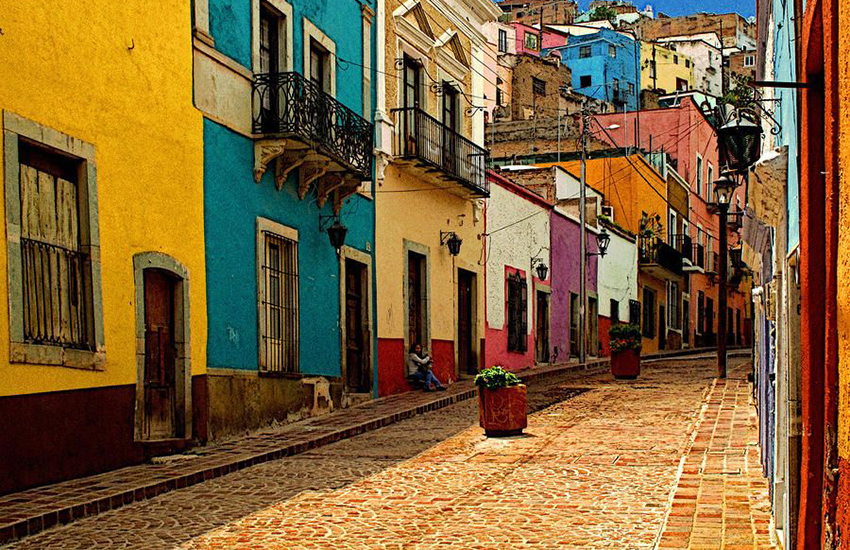
In more modern times, Guanajuato wanted to attract more tourists and visitors, so they became a World Heritage site and had the houses in the city painted in bright colors. These are the two houses across the alleyway from my new apartment.


They also decided to put Guanajuato on the cultural map by adopting Miguel Cervantes as their inspiration.  Guanajuato is the site of all things Cervantino including a museum, an annual festival with readings and performances, a theater (Teatro Cervantes) and statues.  With a few exceptions for historical figures, every statue in Guanajuato is either Don Quixote, Sancho Panza, Dulcinea, or Rocinante.  (The directions to my school from my first apartment:  walk to the first Don Quixote and turn left.  I did get kicked out of that apartment but that’s another story.  I have learned my lesson; no more late night wild parties.)  They even put up a marker for Cervantes' "tomb" although this is no chance that he is buried here.
A typical outside mural

A modern (legless) Rocinante in front of the University

The narrow streets and alleyways of Guanajuato have led to its own Romeo and Juliet story. Supposedly a poor young miner lived across this narrow alleyway from a rich family. (Stop right there. Impossible set-up.) One day the father found his daughter kissing the miner by leaning in from each balcony. So he ... of course ... killed his daughter. My excellent guide told me she has seen photos from the 1930's and the balconies were not there. Oh well.  Visitors come from all over to kiss in the Callejon de Besos, the  Alleyway of Kisses, for good luck


I do spend my afternoons visiting the museums here. The Cervantes museum, of course, the municipal museum, and the Alhondiga. The most pleasant surprise: Diego Rivera’s childhood house. He was born here but his family left when he was 6. No matter; Guanajuato can still claim him. The museum exhibits early works and sketches, no full blown murals. It turns out that his talent was recognized early on and he received a scholarship to study in France and Spain where he met and studied with, among others, Picasso and Cezanne. In one room were exhibited Rivera’s cubist works that looked like they could have been Picasso’s. Who knew?

I also attended a concert at the Teatro Principal.  Guanajuato has an excellent symphony orchestra that is somehow connected with the University of Guanajuato but is made up of professionals, not students.  I was sitting in the middle of a sea of English speakers.  One of the men (American) told me he had moved to Guanajuato in large part because of the symphony.  I pointed out that the orchestra seemed very white to me.  He acknowledged that there has been little appreciation for European music but that is slowly changing.  Mexico has benefited from an influx of Russian musicians who chose to leave their homeland.  The concert master was Ukranian.  These musicians are training the next generation.  


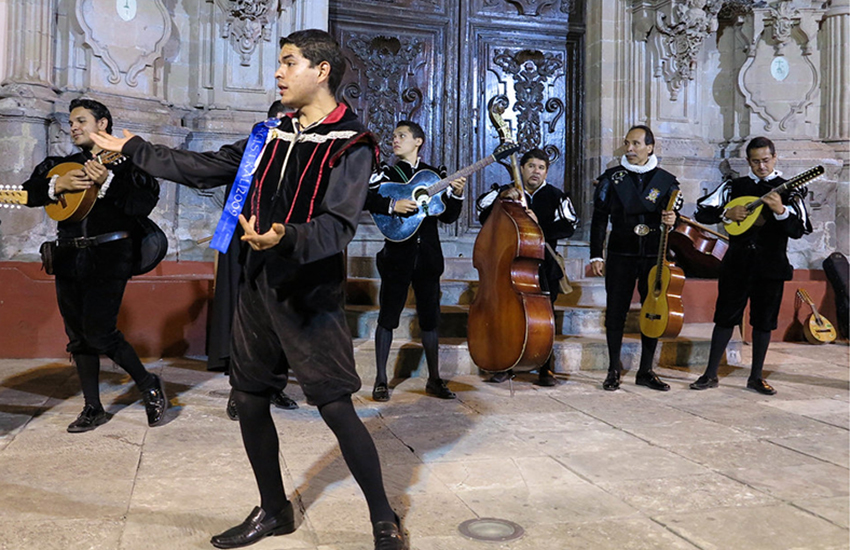
More typical of the musicians in Guanajuato are these estudiantinas - an echo of student singers of bygone eras who literally sang for their supper.  These modern troubadours lead groups of tourists through the alleyways every night, singing and telling stories and jokes.  Teddy, you too can carry your bass vionin through the alleyways of Guanajuato.  And there are mariachi bands everywhere, playing music, resting, and checking their cel phones.