Tuesday, February 21, 2023

If it's Jujuy it must be Utah


I am staying in Salta for five nights to visit the scenery in the Jujuy (pronounced hoo-hooey) province.  Fortunately, Salta is centrally located; unfortunately the distances are quite long, so our daily trips are scheduled to start before 7 in the morning and end after 8 at night.  All of the tours are in Spanish with primarily Argentine tourists.  In general, I can understand about half of what I can hear.


My first trip - to Cachi - was underwhelming.  The highlight was a twenty mile switchback climb over Cuesta del Obispo (the Archbishop’s Slope).  It was one of those amazing feats of engineering with a great view at the top.  Then we descended into the Valle Encantado (Enchanted Valley) where the guide told us we were going to see the biggest cardones in the world.  Since I didn’t know what a cardon was, I had no idea what we were going to see.  But I soon figured it out.


On my second trip the scenery went from good to spectacular.  The Quebrada de los Conchas are red rock mountains with straight up cliffs.  They are so named for the fossils of seashells (conchas) that can be found in them.  It felt like I was in Zion National Park.  And our lunch and shopping stop in Cafayate was much nicer than in Cachi the day before. In Argentina, the national stone is rose quartz and I might have bought a few necklaces. In the Quebradas, the stone is onyx in different colors ... and I might have bought a few.


I was expecting the third day to be the highlight as we were going to Humahuaca to see the famous Quebrada de Humahuaca, a narrow mountain valley with dramatic and colorful mountain formations.   The day did not begin auspiciously.  I was scheduled to be picked up between 5:30 and 6:00 so I dutifully got up at 5:15.  Ugh.  The bus finally arrived at 7:00.  I was not happy.  I could have slept another hour.  Then, after driving for just over an hour, the bus broke down.  We limped into a gas station/mini-mart, where they told us we would wait for an hour or so for another bus.  One hour went by, two hours.  Did I say I was not happy this morning when we were only an hour late?  And I’m the only one who seems to be upset.  I went outside and told our guide we were never going to get to Humahuaca.  Of course we will, he said.  An Argentine woman told me you have to stay positive.  She shrugged her shoulders:  it was a mechanical problem.  What can you do? The bus finally arrived after nearly three hours and we set out for Humahuaca just after noon.  Four hours late.  Seriously?  I figured we would have to turn around sooner than later.


But I calmed down when the spectacular scenery I was expecting began.  The colors of the Quebrada mountains are just amazing. This was one of the views from the window of the bus. The mountains did not seem to be bare rock but looked like they had scattered trees on them. When we got closer, I saw it was the cardones (elephant cactus) that I had seen earlier dotting the hills. Such an unusual landscape.


The tour company had warned us that it was Carnaval this weekend in Jujuy province and we were not making the usual two hour lunch and shopping stop so I thought we might make up some time.  Nope.  They just meant we were going to a different town for our two hour lunch and shopping stop. We went to Purmamarca, a delightful market town full of colorful shops and stalls.  Yes, it is all for the tourists, but I liked it nonetheless.  Did we shorten our stop?  No.  We left Pumamarca at 4:00 and hit stop-and-go bumper-to-bumper traffic from all the people driving to Humahuaca for Carnaval.  I couldn’t believe that we continued to drive north.  At 4:40 I saw a road sign that said 48 kilometers to Humahuaca.  But we were barely moving.  At 5:40 the next sign said 42 kilometers.  Then we came to a complete stop as the road through Tilcara was blocked by a Carnaval parade.  We stopped again in Uquia for another Carnaval event.  Then we stopped for a photo op at the marker for the Tropic of Capricorn.  (Really? We can't skip anything?) At 7:20 I saw another sign that said 11 kilometers to Humahuaca.  We finally arrived around 8:00.


We walked around Humahuaca for a while where Carnaval was in full swing.  The town was rocking.  People paint their faces and wear devil masks and costumes.  There was lots of live and recorded music blaring everywhere and periodic parades.  People also walk around with aerosol cans of something like silly string but it is white confetti.  They spray that and white powder on everyone they walk by. Uncostumed peple paint their faces.


Our guide took us to a restaurant and asked if we wanted to take our food to go on the bus or eat there.  The Argentinos unanimously wanted to stay there and eat.  So we stayed in Humahuaca until after 10.  Since service in restaurants is beyond slow, I had more time to walk around and experience Carnaval.  Typically, the ride to Salta from Humahuaca is three hours. We left Humahuaca around 10 but with the delays of Carnaval …  I was dropped off at my hotel just before 3 AM. My phone and hearing aids had died but fortunately my Kindle had enough charge for the day (and night).


I thought about blowing off my last tour to Grandes Salinas (Big Salt Flats) but, hey, I can sleep when I’m back home.  I was scheduled to be picked up between 6:30 and 7:00, I dutifully got up at 6:00 after three hours sleep, and the bus arrived at … 8:00.  I’m getting the hang of Argentina.  I really did not know where Grandes Salinas was; I thought it was south in the direction of my first two tours, but we went back on the road to the north through the amazing Quebrada.  Well worth the drive.  Also, the colors were more vibrant earlier in the day. This time we drove on another amazing switchback road over a 13,000 mountain.  The views just keep getting better.


I’ve seen other salt flats and mines, and was not expecting much, but it really was fascinating. It was huge!  In one section they let cars drive.  In the main section, people walk around and look at the “swimming pools.”  They cut long narrow holes in the salt to collect rainwater, and then harvest the salt when the water evaporates. The salt flats stretch for miles and look like a giant ice skating rink, but obviously, the surface is solid and tastes like salt. Duh!


After Grandes Salinas, we went back to Purmamarca, the market town I had been to the day before, and the site of the Cerro de Siete Colores (the Hill of Seven Colors).  Since I had already explored the markets and bought more than I should, I found a small, quiet parilla and had one of the best meals I have had in Argentina.  A parilla is a grill, and an authentic parilla is over an open wood burning pit.  This was an authentic parilla.  Also, Carnaval was going on in Purmamarca that day, so I got to see the dancing devils and get sprayed with white powder again.


Traveling with just Argentinos was an interesting experience.  If there had been other Americans on the bus, we would have complained to each other and worked ourselves up over the terrible service.  But no one was upset at the delays or concerned about arriving home six hours late in the middle of the night.  On the plus side, if the bus had not broken down, we would have left  Humahuaca long before dark and I would not have had the chance to see the Carnaval celebrations.  I finally understand how the Argentinos can eat dinner at 9 or 10 at night.  First, they cannot tell the difference between on time and four hours late.  Second, they really mean it when they say “tranquilo” to everything. (Tranquilo means roughly: relax, chill, no worries, hakuna matata.)  And third, they can fall asleep anytime, anywhere.  They all got their sleep on the drive up and the drive back. Outside of Buenos Aires, a lot of shops do close for a couple of hours at midday.


Back in Salta … on my last day I had until 4 before I had to go to the airport to return to Buenos Aires.  Amazingly, there is a free walking tour of Salta every morning, so I signed up.  But there wasn’t much to see because it was … Carnaval … and February 20 … and a Monday.  A triple reason for everything to be closed.  February 20?  It turns out that the famous Battle of Salta in the Argentine war of independence was won by General Belgrano on February 20, 1813. Who knew? So after taking us to one old building, the guide took us to the Gaucho parade that celebrates this historic military victory.  Lots of people dressed us in gaucho clothes and riding horses.  Interestingly, there were several women riding side saddle.


My transport to the airport was scheduled for 4:10 and he came around 4:45.  Tranquilo.  I finally got back to my hotel in Buenos Aires at 10 at night where the streets are packed because … it is Carnaval.  A great time to be in Argentina.  Next I am off to Bariloche, the gateway to the northern part of Patagonia.  It is full of lakes and mountains which I will see on long bus tours.  I wonder how long a 12 hour tour takes in Bariloche.


Tuesday, February 14, 2023

Patagonia: more beautiful scenery

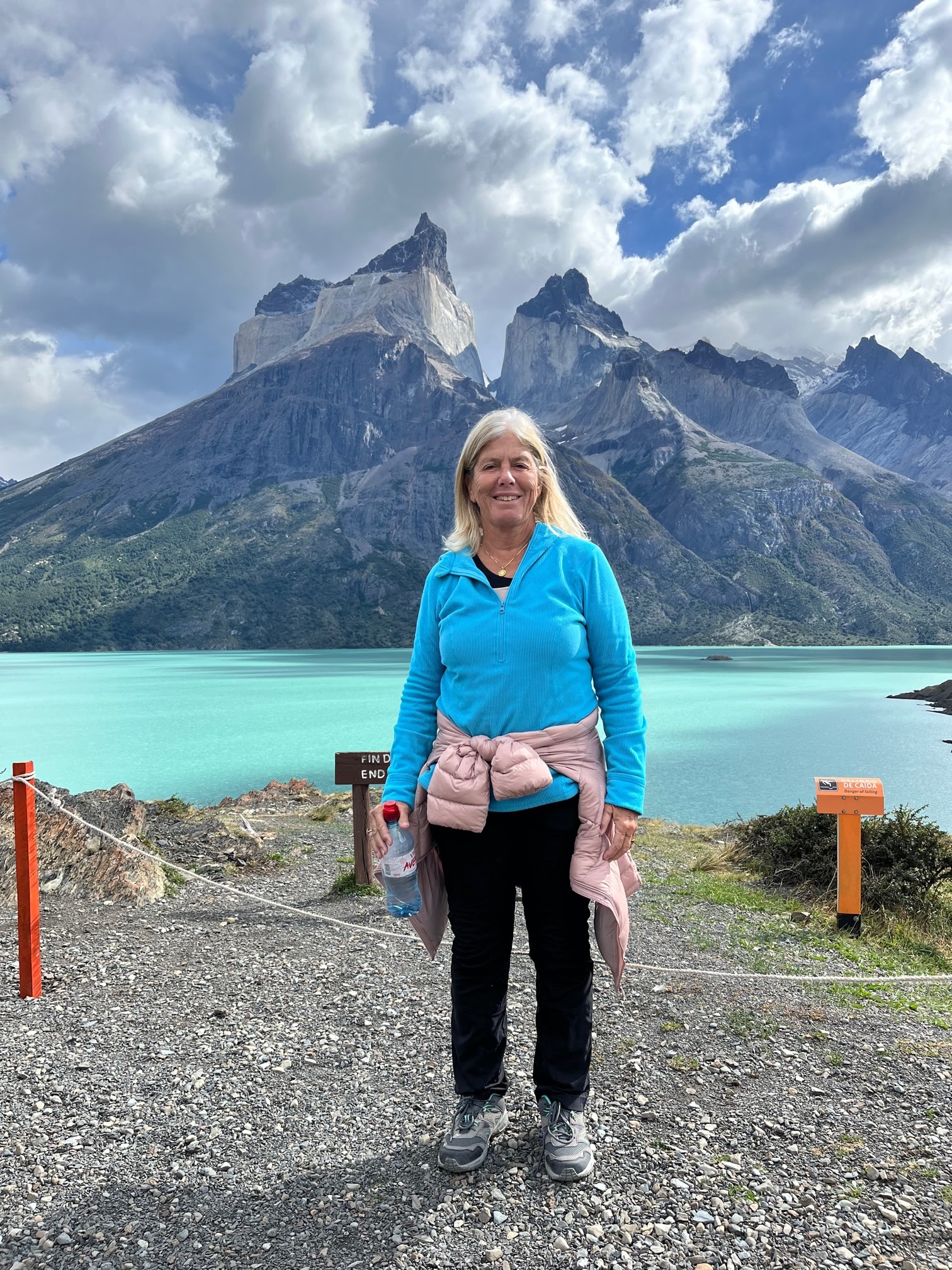
Two Horns Mountain

Our cruise ended in Punta Arenas and we had a long drive to the national park of Torre del Paine.  Think Montana - rugged mountains and blue-green lakes.


Mirror lake of a glacier

We stayed for two nights at the lodge in the park, and explored on horseback the second day.

The next day we had a six hour drive to El Calafate and the reason that I chose this particular tour.  I wanted to see the Perito Moreno Glacier, which is supposed to be one of the biggest and most spectacular of all the glaciers.  And it is.  

Unlike the stunning scenery at Torre del Paine on the Chilean side of Patagonia, the drive to El Calafate is mostly through bare scrubland.  We stopped on the way at sheep estancia (ranch) where we were served lamb asada and given a demonstration of the sheep dogs and shearing.

After a night in El Calafate, we drove to the Perito Moreno Glacier.  Words cannot do this one justice.  It is HUGE.  It stretches more than fifteen miles from the ice fields to the lake in front of it.  We observed it from the opposite shore.


Unlike the slow moving glaciers in Antarctica, Perito Moreno grows up to six feet per day.  It is up to 200 feet tall.  We watched it calve many times and it seemed like small pieces falling into the lake, our guide said the chunks were the size of a house.  Also, like thunder and lightning, you have to be looking at it when it calves because the sound reaches you two seconds later.  By the time you hear the loud crash and turn your head, it is too late.


A few last photos of beautiful scenery:


Friday, February 10, 2023

Patagonia: It's all about the scenery

The first day of my Patagonia trip was actually a day touring Buenos Aires.  A bit of a redo for me but we did have two interesting meetings with local people.  Before lunch, we met with Manuel who discussed the desaparacidos.  The military junta that ruled from 1976 to 1983 brutally kidnapped and murdered over 30,000 Argentinos, many of them young college students.  The government did not acknowledge arresting these people but said they seemed to have disappeared.  Maybe they went into the jungle to smoke pot?  So they are called the desaparacidos - the disappeared ones.  Manuel’s mother was disappeared when he was fifteen days old.  He shared his experience of being raised by his grandparents and later his father who had gone into hiding at first to avoid being disappeared himself. In the evening we had dinner at the homes of local families.


Then on Friday, we flew to Ushuaia, the end of the world.  The tip of South America is over a thousand miles farther south than Australia or Africa, so this is the southernmost city in the world.  It is absolutely beautiful with the Andes mountains rising practically straight up from the sea.  Again we had dinner with a local family.  The town is built going up the mountain, so the view was incredible from their house.  Our guide, Barbara, and our host, Gabby, are friends and each has two daughters.  The four girls are avid ice skaters, rising before 4 in the winter to train at the outdoor rink here.  I would say that there is not a lot to do in Ushuaia in the winter.


Little known geographical fact:  the Andes run north-south through South America, but at the tip, they take a sharp left turn and run east-west through Patagonia.  Then they continue under the Atlantic, and the tips of the taller mountains are the South Atlantic Islands.  And apparently, Antarctica, as well, is a continuation of the Andes.  Second little known geographical fact:  the southern tip of the mainland of South America is Cape Froward.  Below that, the Strait of Magellan connects the Atlantic and Pacific Oceans, and separates the mainland from the hundreds of islands to the south.  This region is called Tierra del Fuego, and it stretches to the south and east with many channels between the islands.

I visited two museums in Ushuaia - the local history museum and the End of the World Museum.  The history museum is located in a building that used to be a prison.  In the late nineteenth century, Argentina had the brilliant idea for populating southern Patagonia:  copy Australia.  So they sent ten skilled prisoners to Ushuaia to build the prison and then more prisoners to inhabit it.

We had one more personal “testimony” before lunch from Osvaldo.  By 1982 the military junta was increasingly unpopular, so they decided to send an expedition to the Malvinas Islands to reclaim them from the British who had taken them over in the 19th Century.  The British call the Malvinas the Falkland Islands but that name is the F-word here.  Somehow, the junta never expected that the British to fight back, so they sent untrained drafted 18 year olds with barely any weapons to reclaim (invade?) the islands.  Surprise, surprise.  Margaret Thatcher was also unpopular, so rallying the troops to fight a war was a great idea to her.  


Osvaldo was one of those 18 year olds.  They sent these boys to the Malvinas with one change of clothes and no winter uniforms although the war took place in the late fall.  Also, Argentina was unable to resupply them so the boys ended up with no food to eat.  Things did not work out well for Argentina in the war, but the defeat did bring down the brutal military government.  Argentina is proudly celebrating 40 years of democracy this year.

And finally, in the evening, we boarded our ship and set sail for Cape Horn.  We were warned before we started that we could only land on Cape Horn weather permitting so not to get our hopes up as the weather is frequently uncooperative.  It turns out that Cape Horn is on the southernmost island in Tierra del Fuego, but you have to cross rough ocean water to get to it.  So we gathered in the lounge at 6:45 AM, awaiting word from the crew as to whether the conditions were favorable for landing.  I can honestly say that I did not get my hopes up and was not the least bit crushed when the captain determined that landing was not possible that day.  Oh darn.  I didn’t have to go out into the cold and wind on a zodiac to reach an island and climb a hill, just to say that I was there.  It is hardly a scenic place.  The weather continued to worsen as we sailed back across the channel to the more protected parts of Tierra del Fuego.  The captain cancelled the scheduled bridge tour and sent us all to our rooms with no lunch.  Eventually, we reached calmer waters and lunch was served.


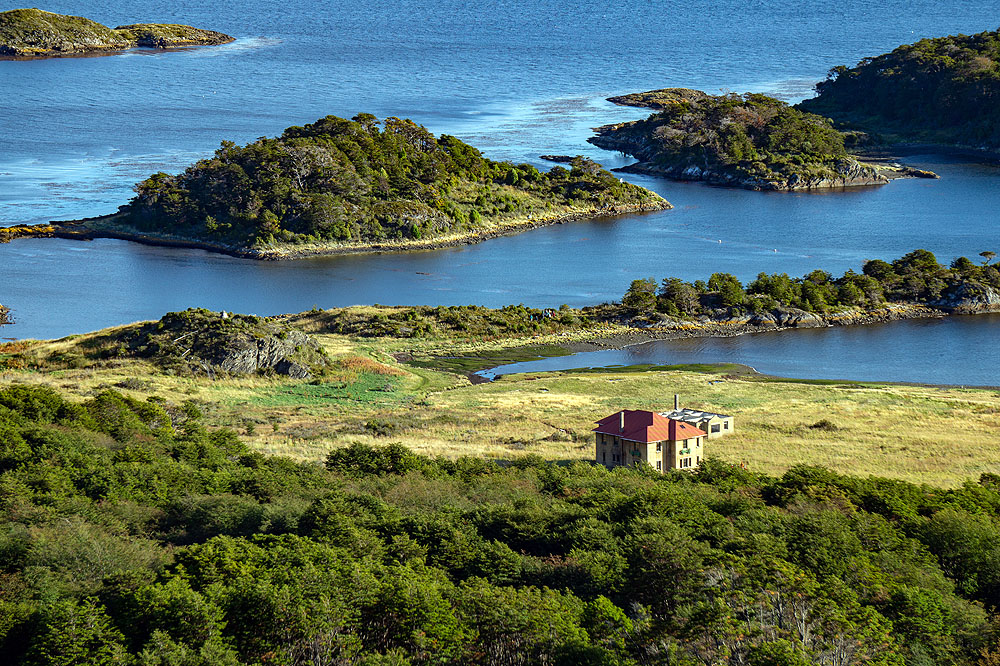
In the afternoon we successfully landed at Wulaia Bay nearly one hundred years after Charles Darwin and the Beagle sailed here.  A lot in Tierra del Fuego is named after Darwin and our guide happily (and mistakenly) informed us that Darwin had invented scientific method and the cataloguing of animals.  He also informed us that Darwin (Columbus?) did not call the local people natives but indigenous because he thought they were in India.  Our guide was very entertaining, but I took everything he said with a large grain of salt.  We had a very pleasant hike up the mountain for a few of the surrounding area.

On the second day of the cruise, the scenery went from nice to spectacular.  Our morning excursion was to the Pia Glacier where we hiked along the side of it, seeing it from different perspectives as we climbed.  Then in the afternoon we went back in the zodiaks to the base of the glacier and got to see it calve.  Just amazing.

The next day we hiked along the beach to the base of Aguila Glacier.  We are in the middle of the Darwin Glacier field.  Between the mountains and the glaciers, the scenery is incredible.  And we are so remote that there is not a single person or settlement on land.  In fact, not many animals either, just some birds, as few animals can live here. Some more incredible pictures of the landscape we have seen:


And finally, on the last morning of the cruise, we stopped at Magdalena Island to see the Magellan penguins. Then we departed the ship for the second week of our Patagonia tour.


Monday, January 30, 2023

Ramblings through and about Buenos Aires

Last weekend my trip was to Colonia del Sacramento, the colonial town across the river in Uruguay.  You might say that I went to Old Sacramento.  I hadn’t realized that the Portuguese got this far south and that Uruguay was the borderland where the Portuguese and Spanish fought it out.  Eventually the Spanish prevailed, so I don’t really understand why Argentina and Uruguay are separate countries. 

As I wander around, I end up with a list of questions to ask my teacher in school the next day.  Sometimes it is about some behavior I can’t understand but usually it is language related.  I took a picture of this sign for my teacher because I had trouble translating it.  It says:  I couldn’t figure out what to wear so I put on happy.

I hadn’t bothered changing any money in Uruguay, so when I went into a minimart to buy a Diet Coke, I asked if they would take Argentine pesos.  They did, but gave me my change in Uruguayan pesos.  No problem.  Later I went to a different minimart that would not take Argentine pesos.  Nor would they take dollars or a credit card.  Only Uruguayan pesos or a debit card.  It is a surreal experience to have hundreds of dollars in my pocket and not be able to afford a soda.


This weekend I made an excursion to an estancia (ranch) for an "authentic gaucho experience."  We did a trail ride where I kept hoping my horse would stay in line and not trot. He did seem to want to once, but I found the brakes, I mean the rein things.   After riding through the fields, we were served “the best empanadas in Argentina.”  I have to say they were the best I have had here.  Then an asada lunch.  First three kinds of sausage.  Then chicken.  Then spare ribs.  When they brought out steak I thought we were done, and I was disappointed that it was a little tough.  But then they brought out another steak that was delicious.  I should have paced myself so I could have had seconds on the real steak.  But I was stuffed by then.  And there was still dessert.


Last weekend I also went to a few museums. The big surprise for me was the Eva Peron Museum. There are still a lot of Peronistas here and I was having trouble understanding what exactly the movement is and why Eva Peron was and remains so popular. I had understood that she was "just" an actress when she met Peron. It turns out that she was a cross between Eleanor Roosevelt and Ronald Reagan. She was "just" an actress for ten years and was quite successful and popular. But she became concerned about the working conditions and low pay for actors, so she joined the union and eventually became president of the actors' union. By the time she met Peron, she had been an activist for years on behalf of women and the working class. Together they created a movement aimed to help the working class and that is why there are still Peronistas, still fighting for the same issues. Among other things, Evita created a halfway house for homeless people with the goal that they would be helped to get work so they could move on to self sufficiency. I saw the same thing when I visited Eleanor Roosevelt's home in Val-Kill. Amazing how the brilliant idea of helping people find work so they can support themselves keeps getting "discovered" in so many different locations and times.

There are a lot of homeless people in Buenos Aires sleeping on the sidewalks or on park benches and as near as I can tell, no one has a problem with them.  They also seem incredibly mess-free. As I have walked around, I have gotten to recognize a few of the regulars.  The most interesting to me is a woman who sleeps on a very high mattress under an arcade across the street from Plaza Mayor which is the big plaza in front of the Casa Rosa.  Literally, the Pink House, it is the Argentine White House named for its distinctive rose colored stones.

I was alternating my route to and from school since there are a lot of parallel streets that I can take, but lately I have taken the same route every day to see what this woman is doing.  On crowded weekday mornings, she is frequently still asleep when I walk by around 9:15.  When I snapped this picture, I thought she was under the covers, but she was up and across the sidewalk, smiling sweetly at me. 


The next day, she was reading in bed when I came by.  Another day, she was apparently doing laundry in one of the several large Home Depot sized buckets full of water she has along the curb.  One morning it was raining and I got soaked in my non-waterproof raincoat.  When I turned the corner, she was sitting on her bed reading the newspaper.  I have started to walk this way at other times, too.  On the weekends, the area is deserted, but when I walked by late Saturday afternoon, she had a pizza in a box and was sitting on her bed eating.  There are several things stacked around her and a dog that is always sleeping.  And she is always smiling sweetly.

Most of the homeless that I see are men and they sleep right on the sidewalk, sometimes in a doorway or under an overhang.  Unlike in other Latin American countries I have visited, I have not seen any public bathrooms, so I am rather mystified.  Unlike in America, there are not messes in the street where the homeless are. I had not seen any other elaborate establishments like hers until today, when I took a slightly different route and saw these neatly made beds with no garbage strewn around and no people either.


Needless to say, there are a lot of beggars as well, and not infrequently I see a nursing mother sitting on the sidewalk.  A lot of people, including quite a few children, walk around selling socks or packages of tissues, although I have never seen anyone buying.  When I am sitting in the park, or even inside a restaurant, every five or ten minutes someone tries to sell something to me or just asks for money. And again, I recognize the regulars in my neighborhood.

Right after I moved into my apartment, I realized that I had forgotten to ask when and how the garbage goes out.  I’m such a suburban American! I expect garbage pickup.  It took me three days, but I suddenly realized that there were two large dumpsters practically in front of my front door - one for garbage and one for recycling.  There are similar dumpsters on every block.  You take out your garbage whenever you want and put it in the dumpster, and the trucks come by whenever to empty them.

But … not infrequently, I see people going through the garbage, presumably looking for something to eat or anything that has value.  Sometimes, it is a team of two men - one inside the dumpster and one holding it open and receiving items.  Most mornings, sanitation workers sweep around the dumpsters and the area is completely clean, but by the evening, bags of garbage are strewn about from the men taking out bags and going through them.

No conclusions.  Homelessness and poverty are universal and Argentina’s economy is really bad right now.  I wish I understood better how things are handled here.  Where and how do the homeless eat?

Back to my daily life ... My school is on the fourth floor (that would be the fifth floor in America) of a building two blocks from Plaza Mayor.  It has an ancient cage elevator that has two doors that you slide to open and close.  The elevator will not go unless you close both doors, and when you get off, you have to make sure you close them both.


The more I have walked around Buenos Aires, the more I appreciate my slightly rundown but charming neighborhood of San Telmo. Similarly, I find this antique elevator with two doors that you have to slide closed manually charming except ... on the two occasions in the month that I have been here when the elevator was out of service and I had to walk up (and down) four flights.


Finally in the "I'm definitely an old fogy now" category ... Practically everyone here under the age of 30 or so has tattoos and I find most of them somewhere between unattractive and mystifying. Some people have so many that you can't see any; it is all just a blur. One man had his extremities tattooed in a solid block - no design. Some seem very random. And a lot are words or sentences. The other day I sat behind a young woman wearing a sundress and across her shoulder blades was written: Sitting is allowed standing is obligatory. If you are going to write something on your body you could choose something profound by the Beatles like "love is all you need" or "imagine all the people sharing all the world." But "sitting is allowed standing is obligatory?" This is the message you want to share for your whole life? Am I missing the point? Does it mean stand for something? I am totally mystified, and not just in Spanish.


Tuesday, January 17, 2023

Iguazu Falls

My plan is to spend a month in Buenos Aires, taking trips each weekend to a different, relatively close place.  Essentially, Buenos Aires is the hub for all flights in Argentina, so while you cannot go directly between two other places, from Buenos Aires I can get anywhere easily.  Even Santiago, Chile, is less than a two hour flight.  So this weekend was … Iguazu Falls.


I ended up booking the weekend with a random travel agency that I found online because the price they quoted me was less than it would have cost me to book everything myself and they coordinated everything.  I got the flights to Iguazu, two nights in a hotel, touring the falls from both sides (Argentina and Brazil),  and transportation to and from the airports.  I was a little nervous on Friday wondering if a driver would show up, but he did - in an air conditioned sedan, practically a limo here.  The airline tickets worked, the hotel expected me, what could go wrong?


Argentine side of Iguazu Falls

Really nothing, but it turned out to be a moderately frustrating weekend.  On Saturday, a van picked me up along with ten other people and the guide took us on a walk on the Upper Circuit on the Argentine side.  The Upper Circuit goes along the top of the falls, with spectacular views down and around.  After lunch, I was scheduled to go on a boat ride to see the falls up close and personal.  But since it was a hot day, I had my hair in a ponytail, and an eagle eyed boat official noticed my hearing aids.  So I got kicked out.  Turns out you can’t go on the boat if you have hearing aids.  I planned on taking them out anyway so they wouldn’t get wet, but it didn’t matter.  It is a safety issue!  What if there is an emergency and they have to yell instructions over the roar of the water?  They wouldn’t believe that I can hear without them.  If I have hearing aids, I must have a “condition” so I couldn’t go on the boat.  I wanted to sneak on anyway but the guide said I had argued too much and they all knew me.  She said I could go the next day from the Brazil side because “they have different rules there.”  Second choice for the few of us who were not on the boat was a walk on the Lower Circuit which really gave a good view.  I would have enjoyed it more if I were not pissed.


On Sunday, we went to the Brazil side which turned out to be spectacular.  Since most of the falls are in Argentina, you can see them better from Brazil.  Also, the best falls are behind an island that you cannot see from Argentina.  Simply spectacular.


Great view from walkway on Brazil side

Then I finally went on my boat ride.  They warned us that we would get wet and suggested leaving everything in a locker.  I decided to bring everything (passport, wallet, phone, and hearing aids (which I took out to keep dry) in my leather daypack and wear my rain slicker over it.  They also encouraged flip flops or barefoot.  Once I got on the boat and realized I was the only one wearing sneakers, I took them off and put them under my slicker as well.


Then we went off for our ride and … it was not what I expected at all.  I thought it was like the Maid of the Mist in Niagara.  We would see the falls from the water level and get a little misty and damp.  Wrong.  It was an amusement park ride.  They took us to one tall cascade and went into it.  Ha Ha.  We got drenched.  So they did it four more times.  I discovered that my rain slicker was not waterproof as I got soaked to the skin.  All of my clothes were sopping wet.  Ha ha.  The only good news is that my leather bag did keep my passport, wallet, and everything else inside dry.  Whew!


Under the waterfall

I had been checking the weather forecast all week before I came to Iguazu and it called for rain and thunderstorms on Saturday and Sunday.  I dressed accordingly.  On Saturday, it never rained and was hot.  I should have worn shorts instead of the black lightweight pants that I thought would be good for rain.  After I got back to the hotel on Saturday, I went to an outdoor restaurant and sat in the sun.  Five minutes after I ordered, it started to rain, and I had to move to a table with an umbrella.  On Sunday morning, my phone said it was drizzling when I was getting dressed, but when I walked outside, it was nice out.  It stayed warm (but I didn’t wear a ponytail near the boat ride) through the ride under the falls.  With the wind and the sun, we started drying out on the ride back when … it started pouring.  It was like still being under the falls.  And when I got back to my hotel, the sun was out and everyone was at the pool.  But of course I had not brought a bathing suit because the weather forecast was for rain all weekend!


The moral of the story:  the gods and the weather were conspiring against me this weekend? Maybe. I always say that every trip cannot be wonderful or you would not know what wonderful is.  Iguazu Falls is one of the seven wonders of the natural world and was incredible to see.  This weekend may have been a bit frustrating but, oh well. I know what wonderful is.  Coincidentally, thanks to my trip to Africa in 2017 and the Salem wedding a few years ago, I have seen the big three falls - Victoria, Niagara, and Iguazu - all in the last six years.  Iguazu was spectacular and Niagara is powerful, but Victoria has my vote for the most impressive.


I have been underwhelmed by Argentine food.  Everyone told me that I would love it because there is so much steak.  But … since I can’t eat dinner at 9:00 at night, I can never go to a really good restaurant.  They don’t even open until 8:30.  I have found enough restaurants that serve food all day, but every Argentine restaurant has the exact same fairly limited menu.  The best steak is confusingly called bife de chorizo.  I thought chorizo was pork sausage, but even in the kosher restaurant Rabbi Ernesto told me to get bife de chorizo.  That turns out to be strip steak which I find tough.  It is harder to find rib eye.  The side dish is always potatoes, usually fries.  When I ask for a salad instead, it is not instead.  I get charged for a salad which is always lettuce, tomatoes, shredded carrots, and sliced onion with oil and vinegar.  The second meat on the menu is called milanesa and is essentially breaded fried steak (or chicken).  And the third meat is bandiola which our bike guide translated as pig elbow. I didn't know pigs had elbows or any meat on them. One day for a change, I ordered costillas which is ribs and got pork chops.  The more casual cafes have a great variety of sandwiches - ten variations of ham and cheese. Argentina does, however, have really good chocolate.


On a happier food note, a young woman in my class last week was the first person I have ever met who eats NO potatoes.  She will eat fries if they are really fried, and not thick and potatoey.  I can forgive that failing.  I was happy to finally meet someone with such a discerning palate.  Also on a happier note, they put onions in everything here.


Back to the economy.  Since the largest bill is $1,000 pesos, the $33,000 pesos I got when I exchanged $100 was more than I could put in my wallet.  But since the banking system is somewhere between inefficient and nonexistent, you cannot transfer large sums of money.  If you are buying a house, you have to hire a private guard, get a suitcase full of bills from the bank, and take it to your closing.


My school has no afternoon activities on Mondays, and it was sunny and 90 degrees, so I went back to Parque Norte to swim after class. I did make it to the park with just one subway ride and a bus transfer, and made it back to my apartment with one, albeit long, bus ride. In order to swim at Parque Norte, you need a “health” inspection.  Last week, a young woman (a nurse?) had me spread the toes on each of my feet, and then bend over and swish my hair around.  Checking for athlete’s foot and head lice?  Not sure, but I passed last week, and got a certificate good for a month. This week I just showed my official certificate and waltzed in.  Although I have to say, the pool is shallow and filled with hundreds of little kids. I suspect the pool has a fair amount of "impurities" in it that the health inspection cannot prevent.


Tuesday, January 10, 2023

Out and About in Buenos Aires

On my first day of school, I knew that the class they had assigned me to was too basic and I talked to the director about moving up, but she said they didn’t have any groups at my level.  They offered me a private class, but in general, I prefer a group, so I chose to stay and have an easy review week.  That turned out to be a good decision.  On Tuesday, a woman came into the class who had had Covid the week before and did zoom classes, but was now back in person.  Daria turned out to be from San Francisco and had just left her position of thirteen years as Assistant Director of Development at … drumroll … Berkeley Rep.  Since I have been attending plays there for years, we had lots to talk about (in English).  Besides Spanish, this week I learned a lot about what goes on behind the scenes at a theater.


Ricardo, the guide from my bicycle tour, also leads tango tours.  I told him to let me know when he had a group and I would go.  On Monday he texted me that he was taking a British couple on Tuesday night.  Would I like to join them?  Duh!  There are lots of tourist tango shows with professional dancers, but locals go to tango clubs called milongas.  Ricardo is a tango dancer himself, and he explained to us the traditions and subtleties involved.


We met at 10 pm at a milonga aptly named El Beso (The Kiss) where the dance floor is far more crowded than it appears in this picture.  There is not a live band, so there are chairs along all four walls.  The women sit in two long rows on two opposite walls and the men sit on the other two opposite walls.  Even if you come as a couple, dancers do not sit together nor dance only with each other.  There are sets of four dances, with a few minutes break between each set.  During the break, everyone returns to their (separate sex) chairs.  When the music starts for the new set, each man issues a silent invitation to a woman with just his eyes.  The woman nods imperceptibly or looks away.  No public rejections. Only after he has been accepted, does the man walk to the woman and extend his hand.  They dance the set, with a few minutes to talk (and find out each other’s names) during the short interlude between each of the four dances.  Then they all sit down and partner with someone else for the next set.


The tango dance that they do is very stylized, and unlike in the tourist shows, the dancers improvise as they go along.  Ricardo explained the hierachy:  a good woman dancer will not dance with a beginner or an unknown, so although he is a good dancer, if he goes to a new club, he has to be introduced or somehow work his way up.  Also, each milonga has its own personality.  Some are for seniors; some are for younger dancers and the smell of pot permeates.  El Beso was middle of the road and starts at an early hour:  9:30.  Others do not open until midnight or later.  The British couple were tired and left around 11:30.  I had seen a good show and did not want to crimp Ricardo’s action, so I left around midnight too.  Fascinating evening.


Talking between tangos in a set

Each week, a teacher at the school gives a tour (in Spanish) of a different neighborhood of Buenos Aires.  On Wednesday, we went to La Boca - the old, poor neighborhood that is home to the Boca Juniors and their crazy fans. 


It also has a colorful, touristy section and it is the next neighborhood to mine so I had wanted to walk there, but I had heard that La Boca dangerous, and had not been back since my bike tour went there.  The guide said it is safe and well policed until 6 at night, just don’t stay after dark.  Not milonga hours but I am looking forward to wandering around there.


On Saturday Daria and I took a train ride to Tigre, the area that is the gateway to the vast Parana Delta.  Only an hour from downtown Buenos Aires, it also has summer homes and resorts.  From Tigre we took a boat ride to see both the beauty of the delta and the interesting houses.  Then we sat for a while in a cafe and I learned even more about the working of a theater.

My neighborhood, San Telmo, is one of the few to still have old colonial style buildings.  Needless to say, the buildings are not in good shape and the neighborhood was getting a bad reputation.  So someone came up with the idea of holding an antiques market every Sunday, and it worked.  On Sunday I went to the biggest antiques/art market I have ever seen.  The stalls literally went on for a mile on the main street with dozens more on the side streets.  The park where I hang out most nights was stripped of its usual restaurant tables and chairs, and full of antiques.  The only sad thing is that the antiques are relics of MY childhood.  Pushbutton phones.  Are they really antiques?


There were street musicians and a rousing drum band.  It was a huge party all day long.  I had been told that everything is closed on Sundays in Buenos Aires, and that may be true in other neighborhoods, but mine was hopping.


On Monday I went to the local (sorta) public swimming pool - a huge pool complex with soccer fields and basketball courts as well.  It does take two bus rides to get there - if you have a sense of direction and can follow the transportation app on your phone.  Next time I hope to make it in only two rides each way.  Sitting at poolside and reading, I am so happy not to be in the massive storms in Sacramento this week. Another new Spanish word: a swimming pool is a piscina in most places, an alberca in Mexico, and a pileta in Argentina. It is a conspiracy to confuse me.


One last thing about Argentine which makes absolutely no sense.  The official rate of exchange is 175 pesos to the dollar but there is another rate, not exactly black market, which is between 300 and 360 pesos to the dollar.  The second rate is called the blue rate.  All of my guides (including Rabbi Ernesto) said to use the blue rate, and that taking money out of the ATM is the stupidest thing you can do.  (Of course that is exactly what I did when I landed at the airport.) I had not researched this before I came and did not bring a lot of dollars with me to exchange.  It turns out that there are long lines at Western Union because you can somehow transfer money to yourself there and get the blue rate.  I do have a few hundred dollars cash on me, so one day I changed $100 at a local exchange kiosk. They gave me over $33,000 pesos, but since the largest bill is $1,000 pesos, I received a wad that was far too large to fit into my wallet. I did happen to get lucky, however.  Totally unbeknownst to me, two weeks before I got here, the credit card companies started offering close to the blue rate.  So as long as I charge everything, it costs half as much as taking money out of the bank and paying cash.  Go figure.  Does this make any sense at all?